
7 Steps to Unbreakable CRM for Service Businesses
7 Steps to Unbreakable CRM for Service Businesses
In today's dynamic business landscape, forging lasting relationships with your clients is not just a best practice; it is the bedrock of sustainable growth. For service businesses, where client trust and repeat engagement are paramount, Customer Relationship Management (CRM) moves beyond a mere buzzword to become a vital strategic imperative. Yet, many first-time founders, freelancers, and local businesses perceive CRM as an expensive, complex system reserved for large corporations. We systematically analyzed this common misconception, uncovering that an effective CRM strategy is, in fact, highly accessible and absolutely crucial for businesses of all sizes to truly delight clients and maximize lifetime value.
This comprehensive guide will demystify CRM, offering a practical, 7-step framework designed specifically for service businesses. We aim to equip you with the knowledge to implement an "unbreakable" CRM system by 2026, ensuring every client interaction strengthens your brand and bottom line. We understand the journey of starting small, which is why we’ll also explore how an affordable, foundational online presence, like one you can create with OGStart for as little as INR 99, can act as the crucial launchpad for your CRM efforts.
The Evolving Landscape of Customer Relationships and Why CRM Matters More Than Ever
The digital age has fundamentally reshaped how businesses connect with their customers. Clients now expect personalized experiences, prompt responses, and consistent communication across multiple channels. This elevated expectation means that a reactive approach to customer service is no longer sufficient. A proactive, integrated CRM strategy allows service businesses to anticipate needs, personalize engagements, and resolve issues before they escalate, transforming satisfied clients into loyal advocates.
Historically, sophisticated CRM systems demanded significant financial investment and technical expertise. This often put them out of reach for burgeoning enterprises, Instagram sellers, or solo creators. However, the advent of accessible cloud-based tools and platforms has democratized CRM, making it possible for anyone to start building robust client relationships without breaking the bank. The core principle remains: understanding your customer, engaging them effectively, and continuously improving their experience. For instance, a study published by the Harvard Business Review emphasizes that investing in customer retention can significantly outperform customer acquisition in terms of profitability, highlighting the long-term value of a strong CRM strategy. Source: Harvard Business Review
Step 1: Define Your Customer Journey & Identify Key Touchpoints
Before you can effectively manage customer relationships, you must first understand them. This step involves mapping out the entire lifecycle a client experiences with your service business, from initial awareness to post-service follow-up. This "customer journey" helps you pinpoint every interaction point, or "touchpoint," where a client engages with your brand.
- Initial Inquiry: How do potential clients first discover and contact you? (e.g., website contact form, social media, phone call).
- Onboarding/Consultation: What is the process for bringing a new client on board? (e.g., discovery call, proposal presentation, agreement signing).
- Service Delivery: How do clients experience your core service? (e.g., project updates, status reports, progress meetings).
- Follow-up/Feedback: How do you solicit feedback and ensure satisfaction after service completion? (e.g., surveys, review requests).
- Retention/Upselling: How do you encourage repeat business or offer additional services? (e.g., loyalty programs, personalized offers).
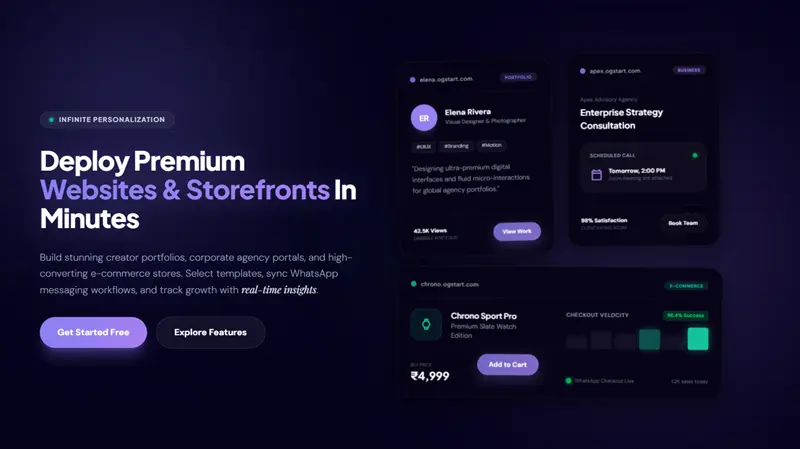
Identifying these touchpoints is crucial for ensuring a consistent and positive client experience. An online presence, such as a professional website or storefront, is often the very first touchpoint for many businesses. Launching a high-quality online presence is easier and more affordable than ever. For those looking to establish their digital footprint rapidly, consider exploring how to Launch Premium Websites & Storefronts - OGStart. This foundational step allows you to capture initial client interest effectively, a cornerstone for any CRM initiative.
Step 2: Identify Your CRM Goals & Metrics
Without clear objectives, your CRM efforts risk being unfocused. This step is about defining what you want to achieve with your CRM strategy and how you will measure its success. Your goals should be SMART: Specific, Measurable, Achievable, Relevant, and Time-bound.
- Increase Client Retention: Aim to reduce client churn by a certain percentage within a specific timeframe (e.g., "Reduce client churn by 15% in the next 12 months").
- Improve Client Satisfaction: Target higher Net Promoter Scores (NPS) or customer satisfaction (CSAT) ratings (e.g., "Increase average CSAT score to 4.5 out of 5 within 6 months").
- Boost Repeat Business/Referrals: Set goals for the percentage of revenue generated from existing clients or client referrals (e.g., "Increase repeat business revenue by 20% in the next fiscal year").
- Enhance Operational Efficiency: Aim to streamline client communication or reduce response times (e.g., "Decrease average client inquiry response time to under 2 hours").
These goals will guide your choice of CRM tools and strategies, ensuring your efforts are always aligned with your overall business objectives. Remember, the ultimate aim is to maximize client lifetime value, making each relationship as profitable and enduring as possible.
Step 3: Choose the Right CRM Tool (or Strategy) for Your Scale
The market is flooded with CRM solutions, ranging from simple contact managers to enterprise-level platforms. For service businesses, especially those just starting, the key is to choose a solution that is proportionate to your current scale and growth trajectory. You don't need to "pay like a big brand on day one."
We've observed that many first-time founders make the mistake of overinvesting in complex systems they won't fully utilize. Instead, focus on tools that offer core functionalities like contact management, communication tracking, task management, and basic reporting. Many excellent freemium or affordable options exist, perfectly suited for individuals, freelancers, and small teams. As your business grows, you can always upgrade.
| CRM Approach | Description | Best For | Key Benefit for Small Business |
|---|---|---|---|
| Spreadsheet & Manual Tracking | Basic contact lists, manual notes, and reminders. | Very early-stage freelancers, solo operators with few clients. | Zero cost, complete control, immediate start. |
| Basic Free/Freemium CRM | Entry-level software with contact management, task tracking, simple pipelines. | Growing freelancers, small teams, those testing business ideas. | Automates basic tasks, provides structure, often free for limited users. |
| Integrated All-in-One Platform | More comprehensive software with email marketing, invoicing, project management built-in. | Established local businesses, creators with a steady client base. | Streamlines multiple functions, reduces tool sprawl, scalable. |
When selecting a tool, prioritize ease of use, integration capabilities (especially with your website or email), and affordability. The goal is to start small and launch fast, validating your ideas without substantial upfront investment. This philosophy mirrors OGStart's approach: enabling you to launch your online presence for a minimal INR 99, allowing you to upgrade only when your business truly grows and demands more advanced features.
Step 4: Integrate Your Online Presence with CRM Basics
Your online presence is often the front door to your service business, making it a critical component of your CRM strategy. This step focuses on ensuring your website, landing pages, and social media channels are optimized to capture client information and initiate relationships.
- Lead Capture Forms: Implement clear, concise contact forms, inquiry forms, and newsletter sign-ups on your website. Ensure these forms collect essential information like name, email, phone, and service interest.
- Call-to-Actions (CTAs): Guide visitors towards desired actions, such as "Request a Quote," "Book a Consultation," or "Download Our Service Guide."
- Live Chat/Chatbots: Consider adding live chat functionality to your website for immediate client engagement and support, capturing lead data directly.
- Email Marketing Integration: Connect your website forms directly to an email marketing service to nurture leads with automated sequences and valuable content.
For many emerging businesses, the first hurdle is simply getting a professional online presence established. OGStart empowers you to build professional ecommerce stores, portfolio websites, business/company websites, and landing pages quickly and affordably. While users are responsible for buying and connecting their own domain, OGStart handles all the complexities of hosting, platform infrastructure, website management, and scaling. This allows you to focus on building client relationships from day one, without the technical overhead. You can even start with an OGStart subdomain and connect your custom domain later, providing ultimate flexibility. This low-risk approach to getting online is perfect for validating business ideas affordably.
Step 5: Standardize Customer Interaction Processes
Consistency is key to an "unbreakable" CRM. This step involves creating standardized processes for how your business interacts with clients at each touchpoint identified in Step 1. Standardization ensures that every client receives a consistent level of service, regardless of who they interact with.
- Communication Templates: Develop templates for common inquiries, welcome emails, service updates, and follow-ups. This saves time and ensures brand consistency.
- Automated Workflows: Use your CRM tool to automate tasks like sending welcome emails to new subscribers, scheduling follow-up reminders, or notifying team members of new leads.
- Client Onboarding Checklists: Create a clear, repeatable process for onboarding new clients, ensuring all necessary information is collected and clients feel supported from the start.
- Feedback Loop Mechanisms: Implement consistent ways to gather client feedback, whether through surveys, review requests, or direct conversations.
Your website can also serve as a powerful tool for standardizing information delivery. A well-organized FAQ section or a blog containing Resources & Insights - OGStart can preemptively answer common questions, reducing the need for repetitive individual responses and freeing up your time for more personalized interactions.
Step 6: Train Your Team & Foster a Customer-Centric Culture
CRM is not just a technology; it's a philosophy. Even the most advanced CRM software will fail without a team that understands its purpose and is committed to using it effectively. This step is about cultivating a customer-centric culture within your organization.
- Comprehensive Training: Provide thorough training on your chosen CRM tool, ensuring every team member understands how to input data, track interactions, and retrieve client information.
- Define Roles & Responsibilities: Clearly outline who is responsible for what aspects of client interaction and data management within the CRM system.
- Emphasize the "Why": Explain the benefits of CRM beyond just data entry. Help your team understand how better client relationships lead to personal and business success.
- Lead by Example: As a founder or leader, demonstrate your commitment to client delight and consistent CRM usage.
A customer-centric culture means empowering every team member to make decisions that prioritize the client experience. It fosters a proactive approach to client needs and encourages open communication, both internally and externally.
Step 7: Analyze, Adapt, and Scale Your CRM Efforts
An "unbreakable" CRM is never static; it continuously evolves. This final step involves regularly reviewing your CRM performance, adapting your strategies based on insights, and scaling your efforts as your business grows. We advocate for an iterative process of improvement.
- Regular Reporting: Utilize your CRM's reporting features to track key metrics like client retention rates, average response times, client lifetime value, and referral rates.
- Client Feedback Analysis: Systematically analyze feedback from surveys, reviews, and direct interactions to identify areas for improvement in your service delivery and communication.
- Process Optimization: Based on your data and feedback, refine your standardized processes, communication templates, and automation workflows.
- Scalability Planning: As your business expands, reassess your CRM needs. This might involve upgrading your CRM software, adding more integrations, or hiring dedicated client success personnel. Remember, with OGStart, you can Let's Launch Your First Project | OGStart and expand your online presence as your business scales, aligning perfectly with this adaptable CRM philosophy.
The Small Business Administration (SBA) consistently highlights the importance of data-driven decision-making for small business success, particularly in customer management. Regularly analyzing your CRM data provides actionable insights that drive continuous improvement. Source: U.S. Small Business Administration
Why OGStart is Your Ideal Partner for Starting Small and Scaling Smart
Implementing an unbreakable CRM strategy requires a robust foundation, and in today's digital economy, that foundation is a strong online presence. OGStart is specifically designed to empower first-time founders, Instagram and WhatsApp sellers, freelancers, creators, and local businesses to establish this foundation quickly and affordably. We embody the core brand message: "Launch your business online for INR 99. Upgrade only when your business grows."
Our platform handles the complexities of hosting, infrastructure, and website management, allowing you to focus on what truly matters: your clients. We help you to "start small," "launch fast," and "validate ideas affordably." You don't need to "pay like a big brand on day one." Instead, you get a professional platform to build your ecommerce store, portfolio, business website, or landing page, serving as a critical hub for your CRM efforts – from lead capture to client communication.
With OGStart, the path to building an "unbreakable" CRM begins with an accessible, high-quality online presence. You can explore our flexible options designed for growth on our Pricing Plans - OGStart page. We are committed to being your partner as you cultivate lasting client relationships and expand your business successfully.
Conclusion: Building Unbreakable Relationships, One Step at a Time
The journey to an unbreakable CRM system is not an overnight sprint but a strategic, ongoing process. By systematically defining your customer journey, setting clear goals, choosing appropriate tools, integrating your online presence, standardizing interactions, empowering your team, and continuously adapting, your service business can build relationships that not only delight clients but also ensure sustained growth and resilience.
Remember, the essence of CRM is genuine client care, amplified by smart processes and accessible technology. Start small, launch fast, and let your client relationships be the engine of your success. With foundational platforms like OGStart, achieving an unbreakable CRM is within reach for every ambitious service business, paving the way for maximized client lifetime value by 2026 and beyond.