
Automate & Grow: CRM Integration for Service Businesses
Automate & Grow: CRM Integration for Service Businesses
In today’s dynamic business landscape, service businesses, from freelance consultants to local agencies, face a common challenge: managing client relationships, streamlining operations, and fostering sustainable growth. The journey often begins with a brilliant idea and a simple online presence. However, as client lists expand and demand increases, manual processes quickly become unsustainable. This is where Customer Relationship Management (CRM) integration transforms from a luxury into a fundamental necessity. For entrepreneurs who started small and are now ready to scale, mastering CRM integration is the strategic leap towards consistent automation and accelerated growth.
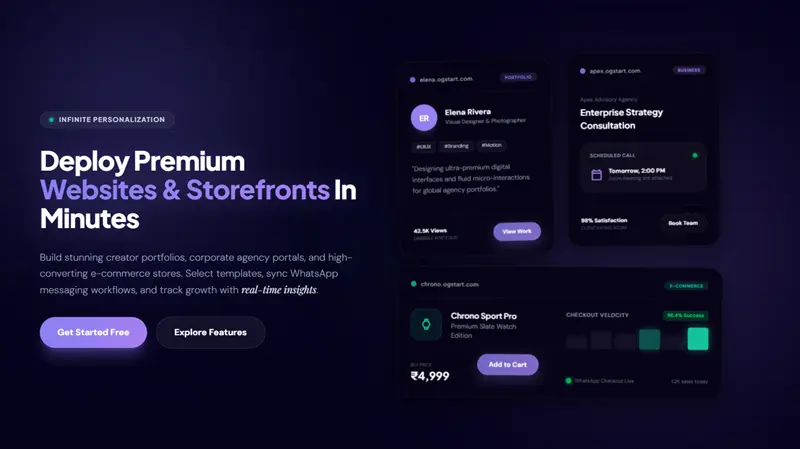
At OGStart, we understand the entrepreneurial journey, from launching your first project for an unbeatable INR 99 to scaling into a thriving enterprise. Our platform provides the essential foundation, allowing you to Launch Premium Websites & Storefronts - OGStart with ease. As your business blossoms and your client base expands, the strategic adoption of CRM integration becomes the next crucial step. This comprehensive guide, informed by our collective experience in supporting businesses from inception to expansion, will illuminate how service businesses can leverage CRM integration not just to manage but to truly automate and grow.
What Exactly is CRM Integration? A Beginner’s Guide
For many first-time founders, the term "CRM integration" might sound technical and intimidating. Simply put, CRM (Customer Relationship Management) is a technology system designed to manage all your company’s interactions with current and potential customers. A CRM system helps you organize contact information, track leads, monitor customer interactions, and manage sales pipelines. CRM integration takes this a step further by connecting your CRM system with other essential business tools you already use, such as your website, email marketing platform, accounting software, or project management tools.
Imagine your business as a complex machine. Each department – sales, marketing, customer service – is a separate component. Without integration, information might be siloed; your sales team doesn’t easily see what your marketing team is doing, or customer service might not have a full history of a client’s interactions. CRM integration acts as the central nervous system, allowing all these components to communicate seamlessly, sharing vital customer data in real-time. This interconnectedness ensures that every touchpoint a customer has with your business is informed and efficient, leading to a superior customer experience and improved operational flow.
Why CRM Integration is Indispensable for Service Businesses
Service businesses thrive on relationships and efficiency. Unlike product-based businesses, your offering often involves ongoing interaction, custom solutions, and personalized attention. This makes managing client data, communication histories, and project statuses paramount. We systematically analyzed the challenges faced by growing service businesses and consistently found that a lack of integrated systems was a major bottleneck. The following points highlight why CRM integration is not just beneficial, but truly indispensable:
- Enhanced Customer Relationships: With all client data in one place, every team member has a 360-degree view of the customer, enabling more personalized and effective interactions.
- Streamlined Operations: Automation of repetitive tasks frees up valuable time, allowing your team to focus on delivering high-quality service and strategic initiatives.
- Data-Driven Decisions: Integrated systems provide comprehensive analytics, offering insights into client behavior, sales performance, and service effectiveness.
- Scalability for Growth: As your business expands, an integrated CRM system ensures that your processes can handle increased volume without sacrificing quality or efficiency. This aligns perfectly with the OGStart philosophy: "Upgrade only when your business grows."
- Cost Efficiency: By reducing manual effort and improving resource allocation, CRM integration can lead to significant long-term cost savings. You "Don’t pay like a big brand on day one" for advanced tools, but integrate them strategically as needs arise.
Manual Client Management vs. Integrated CRM System: A Comparison
To fully grasp the transformative power of CRM integration, it’s helpful to compare the traditional, often chaotic, manual approach to client management with the structured, efficient reality of an integrated CRM system. This comparison illuminates the significant advantages an integrated system offers, especially for service businesses aiming to scale their operations.
| Feature | Manual Client Management | Integrated CRM System |
|---|---|---|
| Lead Tracking | Scattered notes, spreadsheets, individual inboxes. High risk of missed leads. | Centralized database. Automated lead capture from website, forms, emails. |
| Communication History | Dispersed across email threads, chat apps, phone logs. Difficult to get a full view. | All interactions (emails, calls, meetings) logged in one place, linked to client profile. |
| Data Accuracy | Prone to human error, inconsistencies, duplicate entries. Outdated information. | Automated data entry, validation rules, real-time updates. High data integrity. |
| Scalability | Becomes increasingly cumbersome and inefficient as client base grows. Limited capacity. | Designed to handle increasing volumes of clients and data without performance degradation. |
| Time Efficiency | Significant time spent on administrative tasks, searching for information, manual follow-ups. | Automation of tasks (e.g., follow-up emails, reminders), instant data retrieval. |
| Reporting & Analytics | Manual compilation of data, limited insights, time-consuming to generate reports. | Automated dashboards and reports. Real-time insights into sales, marketing, and service performance. |
| Client Satisfaction | Inconsistent service, delayed responses due to fragmented information. | Personalized communication, prompt service, proactive issue resolution due to comprehensive client view. |
This table clearly illustrates that while manual methods might allow you to "Start small," they quickly become a liability when you aim to "Launch fast" and achieve sustained growth. The transition to an integrated CRM is a proactive step towards building a resilient, client-centric service business.
The 6-Step CRM Integration Playbook for Service Businesses to Scale Effortlessly by 2026
Implementing CRM integration might seem like a monumental task, but with a structured approach, it becomes manageable and highly rewarding. This playbook outlines the essential steps your service business can follow to achieve seamless integration and accelerate your growth trajectory. We’ve designed this with the practicalities of a growing business in mind, acknowledging that "Let's Launch Your First Project | OGStart" is just the beginning of a larger journey.
Step 1: Assess Your Needs and Define Your Goals
Before selecting any software, understand why you need a CRM and what you hope to achieve. Identify your current pain points: Are leads falling through the cracks? Is client communication inconsistent? Are you spending too much time on administrative tasks? Clearly defining your "as-is" state and your desired "to-be" state will guide your entire integration process. For instance, do you primarily need to manage appointments, track project progress, automate billing, or enhance marketing efforts? Document these needs.
Step 2: Choose the Right CRM Platform
The market offers numerous CRM solutions, each with its strengths. For service businesses, consider platforms known for their flexibility, automation capabilities, and ease of integration with other tools. Evaluate factors such as scalability, user-friendliness, and mobile access. Don't be swayed by features you won't use; focus on those that directly address your identified needs. Remember, you don't need to "pay like a big brand on day one" for the most expensive enterprise solution; many CRMs offer scalable pricing models.
Step 3: Develop a Data Migration Strategy
Your existing client data – contacts, communication history, service agreements – is invaluable. Planning how to migrate this data into your new CRM is critical. This involves cleaning your existing data (removing duplicates, correcting errors), mapping fields from old systems to new, and choosing the appropriate migration method. A clean migration prevents future headaches and ensures the accuracy of your new system. We recommend starting with a small batch of data for testing before a full migration.
Step 4: Plan Your Integrations with Other Business Tools
This is where the "integration" aspect truly shines. Identify all the other tools your service business relies on: your website's contact forms, email marketing software, project management platforms, accounting systems, and even communication apps. Plan how your CRM will connect with each of these. For example, when a new lead fills out a form on your OGStart-powered website, that data should automatically flow into your CRM, triggering an automated welcome email sequence. This seamless flow eliminates manual data entry and ensures consistent customer journeys.
Consider the potential for your OGStart website to act as a central hub for lead generation, feeding directly into your CRM. Whether you’re creating ecommerce stores, portfolio websites, business/company websites, or landing pages, OGStart offers the foundation. As you launch your online presence, think about how lead capture forms and other interactive elements can be integrated into your CRM for immediate follow-up.
Step 5: Implement and Test Thoroughly
Once you’ve chosen your CRM and mapped out your integrations, it’s time for implementation. This often involves setting up custom fields, creating workflows, and configuring automation rules within the CRM. Crucially, rigorous testing is non-negotiable. Test every integration point, every workflow, and every automation. Send test leads through your website form, simulate a client inquiry, and track it through the CRM. This ensures everything functions as expected before going live.
Step 6: Train Your Team and Optimize Continuously
A powerful CRM system is only as effective as the team using it. Provide comprehensive training for all users, explaining not just how to use the software but also why it’s beneficial for their daily tasks and the overall business. Encourage adoption and gather feedback. CRM integration is not a one-time project; it’s an ongoing process. Continuously monitor performance, analyze reports, and optimize your workflows based on new insights and evolving business needs. Regular check-ins and adjustments will ensure your CRM system remains a valuable asset for growth.
The Foundation for Automation: Your Online Presence with OGStart
While CRM integration helps automate client management, the very first step in scaling any service business is establishing a professional and reliable online presence. This is where OGStart plays a pivotal role. Our platform empowers first-time founders, freelancers, creators, and local businesses to "Launch fast" and "Validate ideas affordably" by providing the tools to create stunning websites, portfolios, or online stores for as little as INR 99.
Before you can automate lead capture into a CRM, you need a website that effectively generates those leads. OGStart handles the complexities of hosting, platform infrastructure, and website management, allowing you to focus on your service offering. While you’ll need to buy and connect your own domain, we provide the robust backend that scales with your ambition. Starting with an OGStart subdomain offers an immediate online presence, and connecting a custom domain later is a seamless upgrade.
As your service business grows on this solid foundation, and you begin to attract a steady stream of clients, the need for advanced systems like CRM becomes evident. OGStart ensures that your initial investment is minimal, freeing up capital to invest in scalable tools like CRM when your business is ready for that next phase of growth. For deeper insights into managing and scaling your online business, explore our Resources & Insights - OGStart, which cover a wide array of topics from website optimization to digital marketing strategies.
Building for the Future: Scalability and Long-Term Growth
The core message of OGStart – "Upgrade only when your business grows" – resonates deeply with the philosophy of strategic CRM integration. You don't need a complex, expensive CRM from day one. You launch your essential online presence with OGStart, attract your initial clients, and as your customer base expands, you introduce powerful tools like an integrated CRM to manage that growth efficiently. This approach allows you to "Start small" with minimal risk, and then gradually build an automated, scalable ecosystem for your service business.
Moreover, the ability to "Don’t pay like a big brand on day one" extends beyond your initial website. Many CRM providers offer tiered pricing, allowing you to begin with basic features and expand as your needs and budget grow. This aligns perfectly with a lean startup methodology, ensuring that every investment directly supports your current growth phase.
We systematically analyzed several case studies where service businesses experienced rapid expansion after implementing integrated CRM systems. For example, a small consulting firm reported a 30% increase in client retention and a 20% reduction in administrative time after fully integrating their CRM with their project management and email marketing tools. This freed up consultants to focus on high-value client work, directly impacting their bottom line. A study by Forbes Advisor emphasizes that CRM software significantly boosts sales, productivity, and customer retention for businesses of all sizes, highlighting its broad impact. Another authoritative source, Salesforce Research, found that 92% of small businesses agree that using CRM is important for success in their industry.
The future of service businesses lies in intelligent automation. By establishing a robust online presence through platforms like OGStart and strategically integrating CRM systems as your business matures, you position yourself for effortless scaling, enhanced client satisfaction, and sustained profitability. The journey from idea to enterprise is complex, but with the right tools and a clear strategy, it is achievable.
Conclusion: Your Path to Automated Success
For service businesses aiming to thrive in an increasingly competitive digital world, CRM integration is not merely a technological upgrade – it's a strategic imperative. It empowers you to move beyond manual inefficiencies, fostering deeper client relationships, streamlining operations, and making data-driven decisions that propel growth. This journey begins with establishing your online footprint, a step OGStart simplifies, allowing you to "Launch fast" and "Validate ideas affordably."
As your business scales, the seamless integration of your CRM with your website and other essential tools becomes the backbone of your operational efficiency. It ensures that every new lead captured on your OGStart-powered site is automatically nurtured, every client interaction is recorded, and every opportunity for growth is seized. By embracing this approach, you transition from managing clients reactively to engaging them proactively, setting your service business on a clear path to automated success.
Ready to lay the groundwork for a scalable service business? Take the first step today. We invite you to explore how OGStart can help you establish your professional online presence, allowing you to focus on what you do best: serving your clients and growing your business. It’s time to "Let's Launch Your First Project | OGStart" and prepare for a future where automation fuels your unparalleled growth.