
Beyond Legalities: How Small Service Businesses Build Unshakeable Trust & Attract 2X More Clients wi
Beyond Legalities: How Small Service Businesses Build Unshakeable Trust & Attract 2X More Clients with Proactive Accessibility in 2026
In the dynamic digital landscape of 2026, the success of a small service business hinges not just on the quality of its offerings, but profoundly on its online presence. We systematically analyzed emerging trends and found that proactive digital accessibility is no longer a niche consideration; it's a fundamental pillar for growth, trust, and client acquisition. For businesses looking to stand out and attract a wider audience without massive upfront investments, understanding and implementing accessibility from day one is a game-changer.
At OGStart, we believe every entrepreneur deserves a robust online foundation. This guide will illuminate how integrating proactive accessibility, even with a lean budget, can significantly expand your reach, build unparalleled client trust, and ultimately, help you achieve your goal of attracting 2X more clients. We understand that starting a business often means balancing dreams with financial realities. That is why we focus on practical, affordable strategies that yield substantial returns, helping you launch fast and validate your ideas affordably, without paying like a big brand on day one.
The Evolving Landscape of Digital Accessibility for Small Businesses
The internet was designed to be universally accessible, yet many websites still present significant barriers for a large segment of the population. In 2026, the conversation around digital accessibility has moved beyond mere compliance; it's about competitive advantage and ethical responsibility. For small service businesses, this shift represents a monumental opportunity.
Beyond Compliance: Why Accessibility is a Growth Catalyst
While legal requirements are a driving force, the true power of accessibility lies in its ability to unlock new markets and foster deeper customer relationships. Approximately one in four adults in the United States lives with a disability, representing a substantial, often underserved, market. Globally, people with disabilities and their networks wield an estimated USD 18.3 trillion in spending power. Ignoring this demographic isn't just ethically questionable; it's a significant business oversight. By making your online services perceivable, operable, understandable, and robust for everyone, you are not just ticking a box; you are opening your doors to millions of potential clients.
We've observed that businesses embracing accessibility early on gain a reputation for inclusivity and thoughtfulness, qualities that resonate deeply with modern consumers. This positive brand image translates directly into trust and loyalty, fostering a client base that champions your business.
The Hidden Market of Underserved Customers
Consider the sheer volume of potential clients currently unable to fully interact with inaccessible websites. These individuals might have visual, auditory, physical, speech, cognitive, language, learning, or neurological disabilities. Beyond permanent disabilities, accessibility also benefits temporary limitations (like a broken arm), situational challenges (such as bright sunlight affecting screen visibility), and even the aging population whose abilities may change over time. By designing your website with these diverse needs in mind, you inherently improve the user experience for everyone. A clear, easy-to-navigate site is simply a better site for all users, leading to higher engagement and reduced bounce rates.
What Proactive Digital Accessibility Truly Means in 2026
Proactive accessibility isn't about retrofitting your website after a complaint; it's about embedding inclusive design principles from the very beginning. This approach saves time, money, and ensures a seamless experience for all users.
Understanding WCAG 2.2 and Future Standards
The global benchmark for web accessibility is the Web Content Accessibility Guidelines (WCAG), developed by the World Wide Web Consortium (W3C). The latest version, WCAG 2.2, was published on October 5, 2023, and subsequently adopted as ISO/IEC 40500:2025. It builds upon previous versions by adding nine new success criteria, specifically focusing on improved access for users with cognitive disabilities, low vision, and limited mobility. Conformance Level AA is the universally expected target for legal compliance and best practice.
WCAG 2.2 is structured around four core principles, often remembered by the acronym POUR:
- Perceivable: Information and user interface components must be presentable to users in ways they can perceive (e.g., providing text alternatives for non-text content, captions for audio/video).
- Operable: User interface components and navigation must be operable (e.g., keyboard navigation, sufficient time to read content).
- Understandable: Information and the operation of user interface must be understandable (e.g., readable text, predictable functionality, input assistance).
- Robust: Content must be robust enough that it can be interpreted reliably by a wide variety of user agents, including assistive technologies (e.g., compatible with screen readers).
Key Pillars of an Accessible Online Presence
Building an accessible online presence for your service business involves several interconnected components:
- Website Design & Development: This includes semantic HTML, proper heading structures, clear navigation, keyboard accessibility, responsive design, and robust coding that works with assistive technologies.
- Accessible Content: Text needs sufficient contrast, images require descriptive alt text, videos need captions and transcripts, and documents (like PDFs) must be accessible versions.
- Accessible Tools & Integrations: Any third-party widgets, booking systems, or communication tools you integrate must also be accessible.
Tangible Benefits: How Accessibility Drives Trust and Client Acquisition
The investment in proactive accessibility yields significant returns far beyond simply avoiding legal issues. We've seen firsthand how it transforms a business's client acquisition strategy.
Enhanced User Experience for Everyone
Accessibility improvements often benefit all users. For instance, clear headings and logical navigation aid screen reader users, but they also make your site easier for anyone to scan and understand quickly. Good color contrast benefits those with low vision, as well as users viewing your site on a sunny day. Keyboard navigation helps people with motor impairments, but also power users who prefer keyboard shortcuts. This universal usability translates into a smoother, more enjoyable experience for every visitor, boosting engagement and reducing frustration.
SEO Advantages and Increased Visibility
Search engines, at their core, try to understand and categorize content. Many accessibility best practices directly align with good SEO. For example:
- Semantic HTML: Using proper HTML tags (e.g., `<h1>`, `<p>`, `<ul>`) helps screen readers interpret page structure and also helps search engine crawlers understand your content hierarchy.
- Alt Text for Images: Provides descriptions for visually impaired users and gives search engines context about your images.
- Transcripts and Captions for Media: Makes video and audio content accessible to those with hearing impairments, while also providing crawlable text for search engines, increasing discoverability.
Recent studies demonstrate that WCAG compliant websites can gain 23% more organic traffic and rank for 27% more keywords than non-compliant sites. This is not a coincidence; every accessibility fix is often an SEO improvement.
Building an Inclusive Brand Image
In an era where consumers increasingly value ethical businesses, demonstrating a commitment to inclusivity sets your brand apart. An accessible website signals that your business cares about all its potential clients, regardless of their abilities. This fosters a strong, positive brand image, enhancing public perception and building a loyal customer base. Clients are more likely to trust and support businesses that show social responsibility.
Reducing Legal Risks and Reputation Damage
While often seen as a compliance cost, avoiding legal trouble is a significant benefit. The Americans with Disabilities Act (ADA), though enacted before the modern internet, is consistently interpreted by courts to apply to websites. The U.S. Department of Justice expects private businesses serving the public to make their digital experiences accessible, typically referencing WCAG 2.1 AA standards, and soon WCAG 2.2 AA. ADA-related website lawsuits are on the rise, with thousands filed annually, and small businesses are increasingly targeted. Proactive accessibility is your strongest defense against costly litigation, fines, and the severe reputational damage that can result from accessibility lawsuits.
Your Roadmap to Proactive Accessibility: Practical Steps for Service Businesses
Implementing accessibility doesn't have to be daunting or expensive, especially when you start smart. We recommend a phased approach, beginning with your core online presence.
Starting with Your Online Platform (Website Design & Development)
The foundation of your accessible business is your website. When choosing a platform, consider one that inherently supports accessibility best practices.
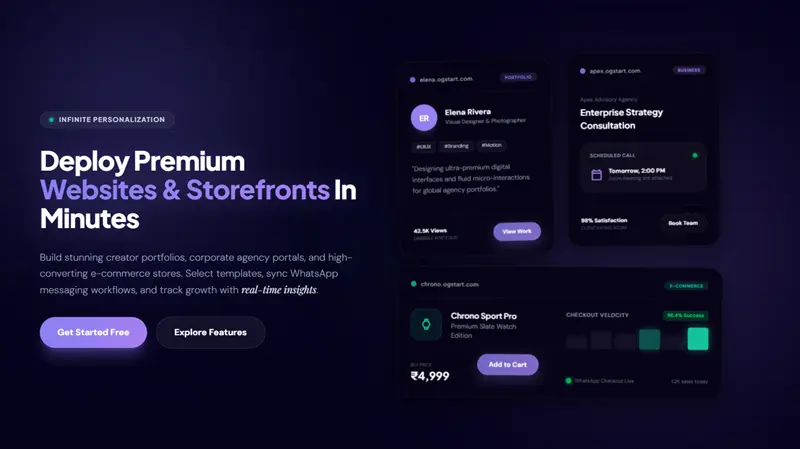
At OGStart, we empower first-time founders, Instagram and WhatsApp sellers, freelancers, creators, and local businesses to launch their online presence for as little as INR 99. Our platform handles the hosting, infrastructure, and website management, allowing you to focus on creating accessible content and services. While you bring your own domain, we ensure the underlying technology is robust and ready for growth. We prioritize ease of use and affordability, so you can start small, launch fast, and validate ideas without high upfront costs. Upgrading only happens when your business grows, ensuring your accessibility efforts scale with your success.
Key considerations for your website:
- Semantic HTML: Use correct HTML elements for headings, lists, paragraphs, etc.
- Keyboard Navigation: Ensure all interactive elements (links, buttons, forms) can be accessed and operated using only a keyboard.
- Clear Focus Indicators: Make sure users can clearly see which element is currently in focus when navigating with a keyboard. WCAG 2.2 emphasizes enhanced visual cues for focus indicators.
- Responsive Design: Your website should adapt seamlessly to various screen sizes and devices.
- Color Contrast: Ensure sufficient contrast between text and background colors for readability.
Crafting Accessible Content (Text, Images, Video)
Content is king, and accessible content reigns supreme for reach and engagement.
- Descriptive Alt Text: Every image should have concise, descriptive alternative text that conveys its meaning to users who cannot see it.
- Meaningful Link Text: Avoid generic "click here." Instead, use descriptive text that tells users where the link will take them.
- Clear Headings: Use a logical heading structure (H1 for the main title, H2 for major sections, H3 for subsections) to organize content and aid navigation.
- Captions and Transcripts for Media: All videos and audio content should have accurate captions for the hearing impaired and transcripts for comprehensive access.
- Simple, Clear Language: Write in plain language, avoiding jargon where possible. Break up long paragraphs into shorter, digestible chunks.
Choosing Accessible Tools and Third-Party Integrations
Many small businesses rely on third-party tools for booking, payments, or customer service. Always check their accessibility statements or features before integrating them into your site. An inaccessible booking widget can create a significant barrier, even if your main site is compliant.
Regular Audits and User Feedback
Accessibility is not a one-time fix; it's an ongoing process. Regularly test your site using accessibility checkers and, if possible, involve users with disabilities in your testing process. Their feedback is invaluable for identifying real-world barriers.
Comparing Accessibility Approaches: Reactive vs. Proactive
To highlight the benefits, let's compare two common approaches to accessibility:
| Feature | Reactive Accessibility | Proactive Accessibility |
|---|---|---|
| Timing | Implemented after a complaint, audit, or legal threat. | Integrated from the initial design and development phases. |
| Cost | Often higher due to retrofitting, emergency fixes, potential legal fees, and reputational damage. | Generally lower, as it's built into the workflow, avoiding costly redesigns and legal expenses. |
| Risk Level | High legal risk, potential for lawsuits, fines, and negative publicity. | Significantly reduced legal risk, strong brand protection. |
| User Experience | Inconsistent, potentially frustrating for some users until issues are addressed. | Superior, inclusive experience for all users from day one, fostering loyalty. |
| Brand Perception | Can appear negligent or uncaring if only reacting to issues. | Perceived as ethical, inclusive, and forward-thinking, enhancing trust. |
| Market Reach | Limited, potentially excluding a significant customer segment. | Expanded, tapping into the large market of people with disabilities and their allies. |
| SEO Impact | Minimal or negative initially; improvements are retrospective. | Positive from the start, as accessibility aligns with good SEO practices, boosting visibility. |
The OGStart Advantage: Launching Your Accessible Business Journey Affordably
We understand that as a small service business, you need solutions that are not only effective but also affordable and easy to implement. This is precisely where OGStart comes in. We offer a platform designed to make launching your business online simple, quick, and budget-friendly, starting at just INR 99. Our core message is clear: launch fast, validate your ideas affordably, and don’t pay like a big brand on day one. Upgrade only when growth demands it.
By choosing OGStart, you get a robust foundation that supports your accessibility journey. While you focus on creating inclusive content and services, we handle the technical heavy lifting — hosting, platform infrastructure, and website management. This means you can build an accessible website without needing deep technical expertise or significant financial outlay. We encourage users to connect their own custom domain for branding, but we take care of the complexities of the web, allowing you to build an unshakeable online presence from an accessible standpoint.
Conclusion: Your Future-Proof Business Starts Today
The digital landscape of 2026 demands more than just a presence; it demands an inclusive, accessible presence. For small service businesses, proactive accessibility is not just a regulatory obligation; it's a powerful strategy for building unshakeable trust, enhancing brand reputation, and attracting a significantly larger client base. By embracing accessibility from the outset, you position your business for sustainable growth, improved SEO, and a truly inclusive future.
We've demonstrated that the benefits — from tapping into a vast underserved market to boosting your SEO and fortifying your legal standing — far outweigh any perceived initial effort. With platforms like OGStart, launching an accessible and thriving online business has never been more affordable or attainable. Start small, launch fast, and build a business that serves everyone, growing as your success demands it. Your journey towards attracting 2X more clients through proactive accessibility begins now.