
CRM Integration Blueprint: Boost Client LTV for Service Businesses
CRM Integration Blueprint: Boost Client Lifetime Value for Service Businesses
In today's dynamic digital landscape, service businesses thrive not just on acquiring new clients, but critically, on nurturing and retaining existing ones. The concept of Client Lifetime Value (LTV) stands as a cornerstone for sustainable growth, representing the total revenue a business can reasonably expect from a single client account over their entire relationship. Maximizing LTV is not merely about increasing sales; it is about building enduring relationships, understanding client needs deeply, and delivering consistent, exceptional value. For first-time founders, freelancers, and local businesses, this might seem like a complex undertaking, but with the right strategy and tools, it is entirely achievable.
We systematically analyzed the challenges service businesses face in managing client relationships, from initial outreach to long-term engagement. Our findings consistently point to one powerful solution: effective Customer Relationship Management (CRM) integration. A well-implemented CRM system can transform how you interact with clients, streamline your operations, and ultimately, significantly boost your LTV. This blueprint will guide you through the essential steps to integrate CRM into your service business, leveraging your online presence to foster stronger, more profitable client connections.
Understanding Client Lifetime Value (LTV): More Than Just a Number
Before diving into integration, it's vital to grasp the profound importance of Client Lifetime Value. LTV is a prediction of the net profit attributed to the entire future relationship with a client. For service businesses, where recurring revenue, repeat engagements, and referrals are key drivers of success, a high LTV indicates a healthy, sustainable business model. It reflects your ability to keep clients satisfied, encourage repeat purchases or ongoing service contracts, and inspire advocacy.
Focusing on LTV shifts your perspective from transactional sales to relationship building. Instead of constantly chasing new leads, which can be expensive and time-consuming, you invest in deepening existing client relationships. This strategy not only improves profitability but also creates a more stable revenue stream, reduces marketing costs, and fosters a community of loyal clients who act as brand ambassadors. A robust online presence is the first step towards building these relationships, and platforms like OGStart enable you to establish this foundation affordably.
The Foundational Power of CRM for Service Businesses
Customer Relationship Management (CRM) is a technology for managing all your company's relationships and interactions with clients and potential clients. The goal of a CRM system is simple: improve business relationships to grow your business. A CRM system helps companies stay connected to clients, streamline processes, and improve profitability.
For service businesses specifically, CRM offers unparalleled advantages:
- Centralized Client Data: All client information – contact details, communication history, service requests, preferences, payment history – is stored in one accessible place. This eliminates data silos and ensures anyone on your team has a 360-degree view of each client.
- Enhanced Client Experience: With a complete client history at your fingertips, you can offer personalized interactions, anticipate needs, and resolve issues more quickly and effectively, leading to higher client satisfaction.
- Streamlined Operations: Automate repetitive tasks such as follow-up emails, appointment reminders, and invoicing. This frees up valuable time for your team to focus on core service delivery and client engagement.
- Improved Communication: Ensure consistent and timely communication across all channels. CRM can integrate with email, phone, and social media, maintaining a unified client record.
- Data-Driven Decision Making: Gain insights into client behavior, service performance, and sales trends. CRM analytics can help you identify your most profitable clients, understand churn patterns, and optimize your service offerings.
In essence, a CRM empowers service businesses to move beyond reactive client management to a proactive, strategic approach that builds loyalty and drives long-term value.
Establishing Your Digital Hub: How OGStart Paves the Way
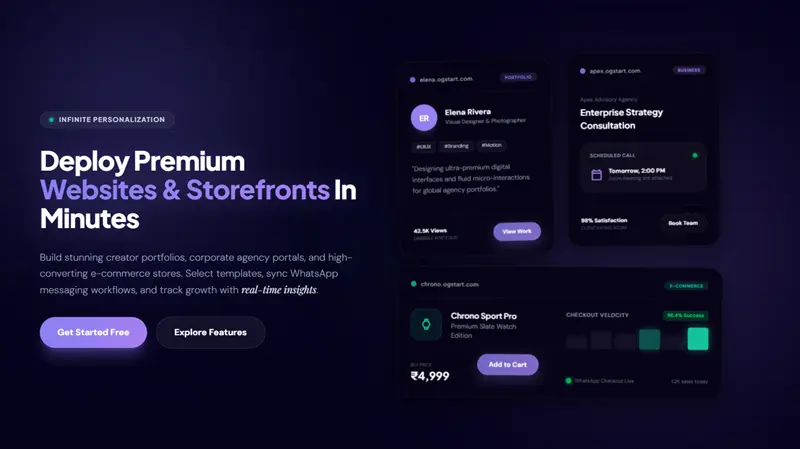
Before you can effectively integrate a CRM, your service business needs a professional, reliable online presence. This is where OGStart plays a crucial role. We understand that first-time founders, freelancers, and local businesses often face budget constraints and technical hurdles when trying to get online. Our platform is specifically designed to overcome these challenges, enabling you to Launch Premium Websites & Storefronts - OGStart for just INR 99.
With OGStart, you can create a range of essential online assets for your service business:
- Portfolio Websites: Showcase your work, client testimonials, and expertise as a freelancer or creator.
- Business/Company Websites: Establish your brand's official online presence, detailing your services, team, and contact information.
- Landing Pages: Design focused pages for specific marketing campaigns, lead generation, or service promotions.
- Simple Online Presence Websites: Get your basic information online quickly and affordably.
We handle the complex aspects of hosting, platform infrastructure, website management, and scaling, so you don’t have to. While you will need to acquire and connect your own domain, OGStart removes the technical burden, allowing you to focus on your services and clients. You can even start with an OGStart subdomain and connect a custom domain later as your business grows. This 'start small, launch fast, validate ideas affordably' philosophy ensures you don't pay like a big brand on day one, and upgrade only when growth demands it.
Once your website is live and serving as your digital storefront or portfolio, you have the ideal foundation to begin integrating powerful tools like CRM. For those ready to take the leap, we encourage you to Let's Launch Your First Project | OGStart and build the digital home for your service business.
Your 7-Step CRM Integration Blueprint for Service Business Websites
Integrating a CRM into your service business is a strategic process, not a one-time task. This blueprint outlines a methodical approach to ensure a successful implementation that directly impacts your Client Lifetime Value.
Step 1: Define Your Client Journey and Objectives
Before selecting any software, gain clarity on your current client journey. Map out every touchpoint a client has with your business, from initial inquiry to post-service follow-up. Identify critical moments, potential bottlenecks, and opportunities for enhanced engagement. Ask yourself:
- How do clients discover your services? (e.g., website, referrals, social media)
- What information do they need at each stage?
- How do you currently communicate with them?
- What are the pain points for clients and for your team in the current process?
Simultaneously, define clear objectives for your CRM integration. Do you want to reduce client churn by 15%? Increase upsells by 20%? Streamline client onboarding to reduce time by 30%? Specific, measurable goals will guide your CRM choice and implementation strategy.
Step 2: Choose the Right CRM Platform
The CRM market is vast, offering solutions for every business size and need. Your choice should align with your defined objectives, budget, and the complexity of your client journey. Consider factors such as ease of use, scalability, integration capabilities (especially with your website and other existing tools), and vendor support.
We systematically analyzed various CRM platforms and categorize them broadly based on their typical target audience and feature sets:
| CRM Type | Primary Features | Best Suited For | Key Consideration |
|---|---|---|---|
| Sales-Focused CRMs | Lead management, sales automation, forecasting, deal tracking, reporting. | Businesses with complex sales cycles, large sales teams, or high-volume lead generation. | May require additional modules for service-specific features. |
| Service-Focused CRMs | Helpdesk, ticketing, knowledge base, client self-service portals, field service management. | Businesses prioritizing client support, issue resolution, and post-service engagement. | Often integrate with sales CRMs for a complete view. |
| Marketing Automation CRMs | Email marketing, lead nurturing, campaign management, landing page builders, analytics. | Businesses focused on automated client communication, content marketing, and lead qualification. | Excellent for building automated client journeys and re-engagement. |
| All-in-One CRMs | Combines sales, service, and marketing functionalities into a single platform. | Growing businesses seeking a comprehensive solution to unify all client-facing operations. | Can be more complex and costly, but offers seamless data flow. |
Step 3: Prepare Your Website for Integration
Your website, especially if built on an intuitive platform like OGStart, serves as a primary client touchpoint. To maximize CRM integration, ensure your site is optimized for data capture and client interaction. This includes:
- Optimized Contact Forms: Design clear, concise forms that capture essential client information without overwhelming them. Ensure these forms directly feed into your CRM.
- Lead Magnets: Offer valuable content (e.g., e-books, checklists, free consultations) in exchange for contact details, pre-qualifying leads for your CRM.
- Call-to-Actions (CTAs): Strategically place CTAs across your site to guide visitors towards conversion points that link to your CRM.
- Mobile Responsiveness: A significant portion of your audience will access your site on mobile devices. Ensure your website and its forms are fully responsive and user-friendly. OGStart websites are inherently mobile-friendly, providing a solid foundation.
- Data Privacy: Ensure your website adheres to relevant data privacy regulations (e.g., GDPR, CCPA) and clearly communicates how client data will be used.
We've observed that a well-structured and engaging website significantly improves the quality of leads captured by CRM systems. If your website isn't performing as expected, consider reviewing our Website Redesign Checklist: Stop Losing Leads, Boost Sales - OGStart for insights on optimization.
Step 4: Implement CRM on Your Website
This is where the technical integration happens. Most modern CRMs offer various methods to connect with your website:
- Form Integrations: The most common method. Your website's contact forms, lead generation forms, and even registration forms can be directly integrated with your CRM, automatically populating client data.
- Live Chat Widgets: Embed a live chat feature from your CRM onto your website. Conversations are then logged directly into the client's CRM record, providing context for future interactions.
- Tracking Scripts/Pixels: Install a small piece of code (often called a tracking pixel or JavaScript snippet) on your website. This allows the CRM to track visitor behavior, page views, and interactions, enriching client profiles with valuable behavioral data.
- API Integrations: For more advanced needs, CRMs offer Application Programming Interfaces (APIs) that allow custom integrations to connect your website with deeper CRM functionalities, such as client portals or personalized content delivery.
Most OGStart websites, designed for ease of use, can seamlessly integrate these common CRM tools, usually by simply embedding a code snippet or connecting through a plugin, depending on the CRM chosen.
Step 5: Migrate and Organize Your Client Data
If you have existing client data from spreadsheets, email contacts, or other systems, careful migration is crucial. Poor data quality can cripple a CRM initiative. Clean your data thoroughly, removing duplicates, outdated information, and inconsistencies. Then, import it into your CRM.
Once imported, organize your data effectively. This includes:
- Segmentation: Group clients based on demographics, service history, engagement level, or profitability. This allows for targeted marketing and personalized service.
- Tagging and Custom Fields: Use tags and custom fields to categorize clients further and store specific service-related information that is unique to your business.
- Automation Rules: Set up rules to automatically assign new leads, update client statuses, or trigger follow-up tasks based on specific actions or data points.
Step 6: Train Your Team and Establish Workflows
A CRM is only as effective as the team using it. Invest in thorough training for everyone who will interact with the system. Ensure they understand not just how to use the software, but also the 'why' – how it benefits them, the client, and the business as a whole. Establish clear workflows and protocols for:
- Lead capture and qualification.
- Client communication standards and templates.
- Service request logging and resolution.
- Follow-up schedules.
- Data entry and maintenance.
Assign clear roles and responsibilities within the CRM. Consistent adoption across the team is paramount for unlocking the full potential of your CRM and driving LTV growth.
Step 7: Monitor, Analyze, and Optimize
CRM integration is an ongoing process. Once implemented, continuously monitor its performance and client LTV metrics. Leverage the reporting and analytics features of your CRM to track key indicators such as:
- Client acquisition costs (CAC) vs. LTV.
- Client retention rates.
- Upsell and cross-sell conversion rates.
- Client satisfaction scores (CSAT, NPS).
- Response times for client inquiries.
Regularly review these metrics and hold team meetings to discuss successes, identify challenges, and brainstorm improvements. Use this data to refine your client journey, optimize your service offerings, and adjust your CRM usage. This iterative process ensures your CRM remains a powerful tool for boosting LTV.
How CRM Integration Directly Boosts Client LTV – Real-World Impact
The systematic implementation of a CRM, especially when built upon a reliable online foundation like OGStart, directly contributes to increased Client Lifetime Value through several powerful mechanisms:
- Personalized Engagement: With a 360-degree view of each client, your team can deliver highly personalized communications and services. This fosters deeper relationships, increases client satisfaction, and significantly reduces churn. A client who feels understood and valued is more likely to remain loyal.
- Proactive Problem Solving: CRM data allows you to identify potential issues before they escalate. By tracking service history and preferences, you can anticipate needs, offer timely support, and even recommend relevant new services, turning potential churn into opportunities for upsells.
- Efficient Service Delivery: Streamlined workflows and automated tasks mean your team can deliver services more efficiently and consistently. This translates to a superior client experience, which is a primary driver of retention and positive word-of-mouth referrals.
- Targeted Upselling and Cross-selling: With clear insights into client needs and purchase history, you can identify the perfect moments and services for upselling or cross-selling, increasing the revenue generated from each client over time.
- Improved Communication Flow: A unified communication record ensures that no client interaction is lost. Whether a client speaks to sales, support, or management, everyone has the full context, leading to seamless and professional exchanges that build trust.
Consider the findings from a recent study by Deloitte, which highlighted that customer-centric companies are 60% more profitable than those that are not. The systematic implementation of CRM directly enables this customer-centric approach. We also find that efficient customer service, powered by CRM, significantly impacts retention. Research published by the American Psychological Association (APA) underscores the importance of positive customer experiences in building loyalty and repeat business. These external perspectives reinforce our internal observations regarding the tangible benefits of CRM for LTV.
Overcoming Common CRM Integration Challenges
While the benefits are clear, we acknowledge that CRM integration can present challenges. Being aware of these can help you mitigate them:
- Data Quality Issues: Starting with messy or incomplete data can undermine the entire system. Invest time in data cleaning and establishing strict data entry protocols.
- User Adoption: Resistance to change is common. Address this through comprehensive training, demonstrating the CRM's benefits, and involving the team in the process from the outset.
- Integration Complexity: Some integrations can be technically challenging. Start with simpler integrations (like forms and chat widgets) and gradually build up. Many CRMs offer robust support and documentation.
- Cost: While enterprise CRMs can be expensive, numerous affordable and scalable options exist for small and growing businesses. Remember, OGStart allows you to launch your online foundation for just INR 99, keeping your initial overhead low so you can allocate resources to essential tools like CRM as your business matures.
Conclusion: Build, Nurture, and Grow with Confidence
For service businesses, Client Lifetime Value is not a luxury; it is a necessity for sustainable growth. Implementing a CRM system is one of the most impactful investments you can make to foster stronger client relationships, streamline operations, and ultimately boost your LTV. This 7-step blueprint provides a clear pathway to integrate CRM effectively, transforming how you connect with and serve your clients.
Remember, every successful CRM integration starts with a solid online foundation. With OGStart, you can Launch Premium Websites & Storefronts - OGStart for just INR 99, providing the essential digital presence your service business needs. Don’t get bogged down by high upfront costs or technical complexities. Start small, launch fast, and validate your ideas affordably. As your business grows and your client base expands, you can integrate powerful tools like CRM, upgrading only when growth truly demands it. Take the first step today towards building a resilient, client-centric service business that thrives on lasting relationships.