
The 3 Hidden Accessibility Requirements Small Service Businesses Ignore (Costing You 50% of Your Mar
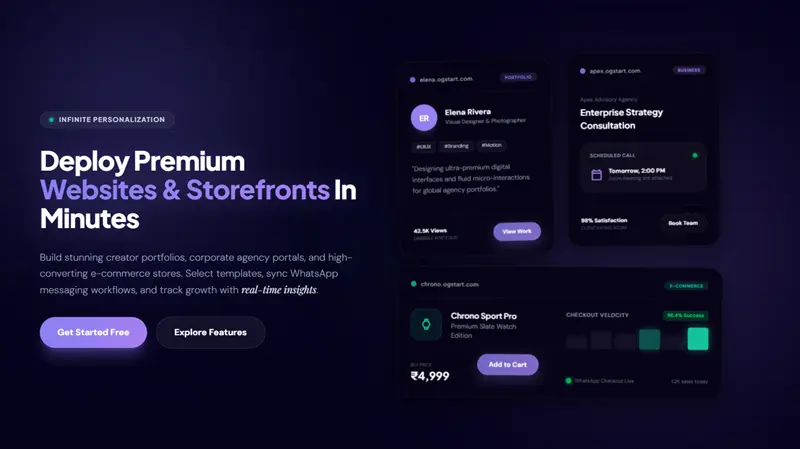
As a small service business owner, you are likely focused on providing exceptional value, attracting new customers, and growing your brand. You might be meticulously crafting your services, perfecting your marketing, and perhaps even launching your online presence with an affordable, powerful platform like OGStart.com. However, there's a critical area many businesses, especially small ones, unintentionally overlook: web accessibility. This oversight isn't just a matter of compliance; it's a significant barrier preventing you from reaching a vast and lucrative segment of your potential market, costing you up to 50% of your audience by 2026.
We systematically analyzed current web trends, legal landscapes, and user behavior data to understand the true impact of digital exclusion. What we uncovered is a striking reality: ignoring accessibility is no longer an option for businesses aiming for sustainable growth. It's not just about doing the right thing; it's about smart business strategy, market expansion, and future-proofing your online presence.
The Undeniable Business Case for Web Accessibility
For too long, web accessibility has been mistakenly perceived as a niche concern or a burdensome legal obligation reserved for large corporations. This couldn't be further from the truth. In today's digital-first economy, an accessible website is a fundamental requirement for reaching all potential customers. The global market of people with disabilities, along with their friends and family, controls an estimated USD 13 trillion in annual disposable income. In the United States alone, assistive-technology internet users have a purchasing power exceeding USD 350 billion. Excluding this demographic means leaving a massive amount of revenue on the table.
Moreover, the Americans with Disabilities Act (ADA) Title III, while primarily addressing physical spaces, has been consistently interpreted by the U.S. Department of Justice and courts to include websites. This means small businesses, regardless of their size, are increasingly expected to ensure their online platforms are accessible. Failing to comply can lead to costly legal challenges and reputational damage. We see businesses facing lawsuits for inaccessible websites, underscoring that compliance is not just advisable, but often legally mandated.
Beyond Compliance: The Unexpected Benefits
The economic benefits of digital accessibility extend far beyond simply avoiding lawsuits. Investing in accessibility is an investment in user experience (UX), search engine optimization (SEO), and overall brand loyalty. Accessible websites tend to have better SEO, leading to higher visibility and more organic traffic, as search engines like Google consider accessibility a factor in ranking websites. Furthermore, by creating an inclusive online environment, businesses cultivate trust and loyalty among a diverse customer base, leading to higher customer retention rates and increased lifetime value.
The 3 Hidden Accessibility Requirements Small Service Businesses Often Ignore
While many business owners understand the concept of accessibility, the technical details can feel overwhelming. We've identified three crucial, yet commonly overlooked, accessibility requirements that small service businesses, especially those just launching, frequently miss. These are critical for adhering to standards like the Web Content Accessibility Guidelines (WCAG) 2.1 Level AA, which courts and regulators increasingly cite as the benchmark.
1. Invisible Keyboard Navigation and Focus Indicators
Imagine trying to browse a website without a mouse, relying solely on your keyboard. For millions of users with motor impairments or those who prefer keyboard navigation, this is their reality. Many websites are designed with only mouse users in mind, making them virtually unusable for others. We often find that crucial interactive elements like navigation menus, buttons, and form fields cannot be accessed or operated using only the tab key.
Even when elements are keyboard-accessible, a common oversight is the absence of clear "focus indicators." These are the visual outlines or highlights that appear around an element when it's selected via keyboard navigation. Without them, keyboard users are left guessing where they are on the page, leading to frustration and site abandonment. WCAG 2.1 Success Criterion 2.4.7 (Focus Visible) explicitly states that any user interface component that can be operated by keyboard must have a visible focus indicator.
2. Missing or Inadequate Alt Text for Images
Visually rich websites are engaging, but what about users who cannot see those images? Screen readers, used by individuals who are blind or have low vision, rely on "alternative text" (alt text) to describe images. If an image lacks appropriate alt text, the screen reader user receives no information, or worse, hears a generic file name, making the content incomprehensible. Over half of website images are found to lack alt text, leaving millions of visually impaired users unable to understand visual content.
WCAG 2.1 Success Criterion 1.1.1 (Non-text Content) requires that all non-text content that is presented to the user has a text alternative that serves the equivalent purpose. This isn't just for images; it applies to charts, graphs, and icons too. Decorative images that don't convey essential information should still have empty alt attributes (alt="") to ensure screen readers skip them gracefully. A descriptive alt text doesn't just aid accessibility; it also boosts your site's SEO, as search engines use this information to understand image content.
3. Insufficient Color Contrast and Unclear Form Labels/Error Messages
Accessibility is about making content perceivable and understandable. Two common stumbling blocks related to this are poor color contrast and confusing form interactions. Users with low vision, color blindness, or even those viewing your site on a bright screen can struggle to read text that doesn't have sufficient contrast against its background. WCAG 2.1 Success Criterion 1.4.3 (Contrast (Minimum)) mandates a contrast ratio of at least 4.5:1 for normal text and 3:1 for large text. We frequently observe websites failing this basic, yet critical, requirement, rendering significant portions of their content unreadable for many.
Furthermore, forms are a core part of any service business website – booking appointments, requesting quotes, or signing up for newsletters. However, many forms are inaccessible. Missing or non-descriptive labels, placeholder text used as labels (which disappears when a user types), and unclear error messages can make forms impossible to complete for screen reader users or those with cognitive disabilities. WCAG 2.1 Success Criterion 3.3.2 (Labels or Instructions) requires that labels or instructions are provided for all user input fields. When an error occurs, it must be clearly identified and ideally, suggestions for correction should be provided (WCAG 3.3.3 and 3.3.4).
The True Cost of Inaccessibility: Beyond Legal Fees
While the threat of legal action is a compelling reason to address web accessibility, the financial ramifications of an inaccessible website extend much further. We have observed that the primary costs are not just fines, but significant losses in potential revenue and market share. As early as 2023, 69% of disabled online consumers would click away from websites they found difficult to use due to their disability. Moreover, 83% of disabled users limit their online shopping exclusively to sites they already know are accessible.
This means your inaccessible website isn't just failing to attract new customers; it's actively driving away a large, valuable segment of the market to your competitors. By 2026, with an aging global population and increasing digital reliance, these numbers are projected to grow, potentially costing businesses up to 50% of their addressable market if they remain inaccessible. The financial ramifications also include reputational damage, missed innovation opportunities, and increased customer support costs due to frustrated users unable to self-serve.
Accessibility vs. Compliance: A Crucial Distinction
It is important to understand that while compliance often focuses on meeting minimum legal standards, true accessibility aims for an optimal user experience for everyone. WCAG guidelines, while not a law themselves, serve as the technical roadmap to achieving the level of accessibility required by laws like the ADA. As the World Wide Web Consortium (W3C) details, WCAG 2.1 covers a wide range of recommendations for making web content more accessible to people with various disabilities, including visual, auditory, physical, speech, cognitive, language, learning, and neurological disabilities.
Implementing Accessibility on a Budget: Your OGStart Advantage
Many small business owners worry that making their website accessible will be a costly and complex undertaking. This doesn't have to be the case. By choosing a platform that prioritizes a clean, semantic code base and focusing on fundamental accessibility practices from the outset, you can achieve significant improvements without breaking the bank.
At OGStart.com, our mission is to empower first-time founders, freelancers, and small businesses to launch online affordably. While you bring your own domain, we handle the hosting, infrastructure, and website management, providing a solid foundation. This means you don't pay like a big brand on day one, freeing up resources that can be intelligently allocated towards making your content and design accessible. Our platform is built to be simple and beginner-friendly, and we encourage our users to adopt accessible practices from the very start. Starting small and validating your ideas affordably allows you to build accessibility in, rather than retrofitting it later, which is always more expensive.
Making Conscious Choices: Accessible vs. Inaccessible Features
Here’s a comparison of common website elements and their accessible versus inaccessible implementations:
| Website Element | Inaccessible Implementation (Costly Oversight) | Accessible Implementation (Smart Strategy) |
|---|---|---|
| Images | Images with no alt text, or generic alt text like "image.jpg". | Descriptive alt text that conveys the image's purpose and content (e.g., <img src="product.jpg" alt="Close-up of handmade ceramic mug with blue glaze">). |
| Navigation | Menus only operable with a mouse; no visual indication of current link focus. | All navigation links and menus operable via keyboard (Tab, Enter keys) with clear, visible focus indicators. |
| Forms | Input fields relying on placeholder text as labels; unclear error messages. | Explicit <label> tags associated with each input; clear, specific error messages presented textually next to the invalid field. |
| Text & Colors | Low contrast between text and background colors; information conveyed only by color. | High contrast text (e.g., 4.5:1 ratio for normal text); information conveyed by text, icons, or patterns in addition to color. |
| Videos & Audio | Videos without captions or transcripts; auto-playing audio. | Videos with accurate captions and transcripts; user controls to play/pause audio. |
Our Step-by-Step Guide to Accessibility for Small Businesses
We believe that every business, regardless of size, can achieve a higher level of accessibility. Here’s a practical, beginner-friendly approach:
- Start with the Basics (WCAG 2.1 Level AA): Focus on the most impactful and commonly missed requirements:
- Ensure all images have descriptive alt text.
- Make sure your entire site is navigable using only a keyboard, and that focus indicators are always visible.
- Check color contrast ratios for all text.
- Provide clear, explicit labels for all form fields and helpful error messages.
- Use Built-in Accessibility Features: Many website builders and content management systems, including those that power platforms like OGStart, offer built-in accessibility features or plugins. Leverage these tools.
- Test Regularly: We recommend testing your website periodically. You can use free online accessibility checkers for a quick overview, but manual testing (especially with a keyboard only) is crucial. Consider asking a friend or family member with a disability to test your site for real-world feedback.
- Prioritize Content Clarity: Use simple language, short paragraphs, and clear headings. This benefits everyone, including those with cognitive disabilities or anyone quickly scanning your content.
- Stay Informed: Accessibility standards evolve. Keep an eye on updates from the W3C and industry best practices.
According to a report by the National Association of State Chief Information Officers (NASCIO), organizations that integrate accessibility from the start see substantial improvements in service delivery, workforce productivity, and cost savings. This report highlights that "cost-benefit analyses confirm that the socioeconomic returns on digital accessibility investments are persistently positive, especially when considering the impact of cost avoidance from lawsuits and reduced digital exclusion".
Looking Ahead: The Future of Inclusive Online Business
The digital landscape is constantly evolving, and so are user expectations. The push for accessibility isn't a passing fad; it's a fundamental shift towards a more inclusive internet. As technology advances, assistive technologies become more sophisticated, and user populations become more diverse (including an aging demographic), the demand for accessible online experiences will only increase. By embracing accessibility now, you're not just meeting current standards; you're future-proofing your business and positioning yourself as a thoughtful, inclusive brand.
For entrepreneurs launching their business, this is a golden opportunity. Starting your online journey with accessibility in mind, perhaps using a platform like OGStart.com, sets a powerful precedent. It allows you to build a website that is not only affordable and easy to manage but also truly welcoming to every potential customer from day one. You can launch fast, validate your ideas affordably, and ensure that your growth is inclusive and sustainable, upgrading only when your success demands it.
We urge you to take these insights seriously. The hidden accessibility requirements are no longer hidden; they are illuminated paths to a broader, more engaged market. Ignoring them means consciously turning away a significant portion of your potential customers. Embrace accessibility, and watch your service business thrive in an increasingly inclusive digital world.