
Master Your UX Portfolio: 4 Steps for Senior UX Roles & Growth
Master Your UX Portfolio: 4 Steps for Senior UX Roles & Growth
In the dynamic and competitive world of User Experience (UX) design, your portfolio isn't just a collection of past projects; it's your most powerful advocacy tool. For aspiring senior UX designers, freelancers, or creators aiming for top-tier opportunities and significant career growth by 2026, a meticulously crafted portfolio is not merely an option, but a critical necessity. It's the narrative that showcases your expertise, demonstrates your impact, and ultimately opens doors to those coveted senior roles and high-value contracts.
However, the journey to building such a compelling online presence can often feel daunting. Traditional website development can be costly, time-consuming, and require technical know-how, posing a significant barrier for many talented individuals. We understand that first-time founders, Instagram and WhatsApp sellers, freelancers, and local businesses are often testing new ideas or operating on lean budgets. This is precisely why platforms like OGStart exist: to empower you to launch your business online for Rs. 99, allowing you to validate your ideas affordably and upgrade only when your business genuinely grows.
This article systematically analyzes the four essential steps to master your UX portfolio. We will delve into how to select and narrate your projects, design for optimal discoverability, showcase thought leadership, and embrace an iterative growth mindset. Crucially, we will also illustrate how OGStart provides an accessible, low-risk, and efficient pathway to establish and scale your professional UX presence online, without the need to pay like a big brand on day one.
The Imperative of a Powerful UX Portfolio in Today's Market
A UX portfolio serves as your professional identity in the digital realm. It's the first point of contact for recruiters, clients, and collaborators, offering a tangible demonstration of your skills, problem-solving abilities, and the impact you've delivered. In a market increasingly saturated with designers, a generic portfolio simply won't suffice. Senior roles, in particular, demand evidence of strategic thinking, leadership, and a deep understanding of the business implications of design decisions.
Today's market has shifted beyond merely displaying pretty mock-ups. Recruiters and hiring managers are looking for comprehensive case studies that articulate the "why" behind your design choices, the challenges you overcame, the research methods employed, and, most importantly, the measurable outcomes. For freelancers and creators, your portfolio is your storefront; it's how potential clients perceive your value and decide whether to invest in your services. Without a robust online presence, showcasing your expertise becomes an uphill battle, limiting your reach and your potential for growth.
We systematically analyzed countless successful UX portfolios and observed a consistent theme: the most impactful ones tell a story. They don't just present artifacts; they narrate a journey from problem identification to solution implementation, highlighting the designer's crucial role at each stage. This narrative-driven approach is what truly resonates, demonstrating not just technical proficiency, but also critical thinking, collaboration, and a results-oriented mindset. Understanding this distinction is the foundation upon which your senior-level portfolio will be built.
Step 1: Strategic Case Study Selection and Storytelling
The cornerstone of a compelling UX portfolio lies in its case studies. For senior roles, the emphasis shifts from merely displaying design output to articulating your strategic involvement and the business impact of your work. It's not about showcasing every project you've ever touched; it's about curating a selection that collectively tells a story of your growth, expertise, and leadership potential.
Crafting Compelling Case Studies
When selecting projects, prioritize quality over quantity. Choose 3-5 projects that are diverse in scope, industry, and the specific UX skills they highlight. For a senior role, this might include projects where you led research efforts, spearheaded a complex interaction design challenge, or played a pivotal role in defining product strategy. Each case study should follow a clear, engaging narrative structure:
- Problem: Clearly define the user or business problem you aimed to solve. What was the context? What were the initial challenges?
- Role & Team: Explicitly state your role within the project team. What were your specific responsibilities? Who did you collaborate with?
- Process: Detail your design process. What research methods did you use (e.g., user interviews, usability testing, competitive analysis)? How did you synthesize findings? What ideation techniques did you employ? Show, don't just tell, your journey.
- Solution: Present your final designs, but also show iterations. Explain the rationale behind your design decisions. Use visuals: wireframes, prototypes, mock-ups, user flows.
- Impact & Learning: This is perhaps the most critical section for senior roles. Quantify the impact of your design with metrics (e.g., increased conversion rates, reduced support tickets, improved task completion times). Discuss key learnings, challenges overcome, and future recommendations. What would you do differently next time? This demonstrates critical thinking and a growth mindset.
Think of each case study as a compelling story. Use the STAR method (Situation, Task, Action, Result) to structure your narratives, ensuring every part of your process is accounted for. Visuals are paramount; well-organized screenshots, animated GIFs of prototypes, or short videos can significantly enhance understanding and engagement. Remember, your portfolio is a showcase of your communication skills as much as your design prowess.
Step 2: Designing for Discoverability and Engagement
Your UX portfolio isn't just content; it's an experience in itself. Just as you would design a product for intuitive usability, your portfolio website must be designed for discoverability, engagement, and a seamless user journey. A poorly organized, slow-loading, or visually unappealing portfolio can detract from even the most brilliant case studies.
Platform Considerations for Your UX Portfolio
The platform you choose for your portfolio website directly impacts its discoverability and your ability to manage it effectively. For first-time founders, freelancers, and creators, the technical overhead and cost of traditional web development can be prohibitive. This is where platforms like OGStart become invaluable.
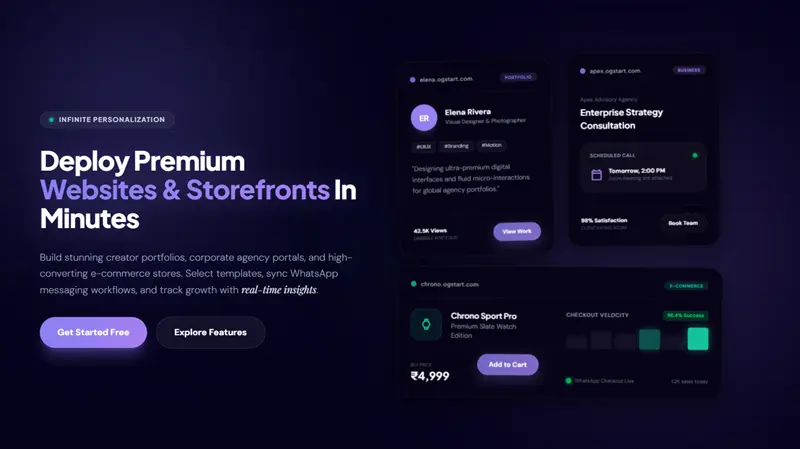
OGStart offers a straightforward solution to Launch Premium Websites & Storefronts - OGStart. It's built for individuals who need an online presence without getting bogged down in complex coding or expensive hosting fees. Here's how it addresses common pain points:
- Affordability: You can launch your entire professional presence for just Rs. 99 initially. This allows you to start small and validate your online presence without significant upfront investment.
- Ease of Use: No coding required. OGStart's intuitive interface allows you to create an aesthetically pleasing and functional website quickly, freeing you to focus on your portfolio content.
- Managed Infrastructure: OGStart handles all the technical complexities like hosting, platform infrastructure, website management, and scaling. This means you don't need to worry about server maintenance, security updates, or ensuring your site can handle increased traffic as your career grows.
- Scalability: The core message is clear: upgrade only when your business grows. As your portfolio attracts more clients or lands you a senior role, OGStart's structure allows you to scale your website capabilities without needing to rebuild from scratch.
- Domain Flexibility: While OGStart provides the robust platform, you still purchase and connect your own custom domain. This gives you full control over your professional branding (e.g., yourname.com) while leveraging OGStart's powerful backend. You can even start with an OGStart subdomain and connect a custom domain later, offering maximum flexibility.
Consider the table below comparing common portfolio setup options:
| Feature | Traditional Custom Development | Generic Website Builder (Free Tier) | OGStart |
|---|---|---|---|
| Upfront Cost | High (Development + Hosting) | Low to Zero (Limited Features) | Very Low (Rs. 99 initial) |
| Technical Knowledge Required | High (Coding, Server Mgmt) | Moderate (Template Customization) | Low (No Coding) |
| Hosting & Infrastructure | User Responsible | Limited, Often Shared | OGStart Handles |
| Scalability | High (with skilled developer) | Limited (Paid Upgrades) | Built-in Growth Path |
| Custom Domain Integration | Full Control (Requires Setup) | Varies (Often Paid Feature) | User Connects (OGStart Hosts) |
| Target Audience | Large Enterprises, Unique Needs | Hobbyists, Basic Presence | First-time Founders, SMBs, Creators |
By leveraging a platform like OGStart, you ensure your portfolio is not only visually appealing and functional but also easy to manage and scale, allowing your professional online presence to grow organically with your career.
Step 3: Showcasing Thought Leadership and Personal Brand
For senior UX roles, simply presenting project work is often insufficient. Hiring managers seek individuals who can contribute to the broader UX community, shape strategic discussions, and demonstrate leadership beyond their immediate project tasks. This is where showcasing your thought leadership and personal brand becomes paramount.
Differentiating Your Portfolio
Beyond your case studies, dedicate sections of your portfolio to demonstrating your deeper engagement with the UX field. This might include:
- Blog or Articles: Share your insights on UX trends, design principles, or specific methodologies. Writing articles positions you as an expert and offers a window into your problem-solving approach and critical thinking. You can find inspiration or a place to host your thoughts by visiting Resources & Insights - OGStart.
- Speaking Engagements/Workshops: If you've presented at conferences or led workshops, highlight these experiences. They demonstrate your ability to articulate complex ideas and influence others.
- Community Involvement: Participation in design organizations, mentorship programs, or open-source projects showcases your commitment to the community and your leadership potential.
- "About Me" Section: Go beyond a standard resume summary. Tell your unique story. What drives you? What are your passions within UX? What kind of impact do you aspire to make? A personal touch can make your portfolio memorable.
- Testimonials: Feature endorsements from former colleagues, managers, or clients. Third-party validation significantly boosts your credibility and trustworthiness.
Building a personal brand takes time, but integrating these elements into your portfolio demonstrates a holistic understanding of what it means to be a senior UX professional. It shows you're not just a doer, but a thinker, a leader, and a contributor to the wider design ecosystem. This differentiator is crucial for standing out in a crowded field and attracting the kind of opportunities that lead to significant career advancement.
Step 4: The Iterative Process – Refine, Network, and Grow
Your UX portfolio is not a static artifact; it's a living document that requires continuous refinement. The design world evolves rapidly, and your portfolio must evolve with it. For those aspiring to senior roles, a commitment to iterative improvement, continuous learning, and active networking is non-negotiable.
The Growth Mindset for UX Professionals
Embrace the philosophy that your portfolio is never truly "finished." Regular updates are essential, especially as you complete new projects, acquire new skills, or achieve new career milestones. Seek feedback from mentors, peers, and even target recruiters. Critically evaluate what's working and what isn't. Are visitors spending enough time on your case studies? Is your call to action clear?
Networking is equally vital. Attend industry events, participate in online communities, and connect with other professionals on platforms like LinkedIn. Share your portfolio and be open to constructive criticism. The insights gained from these interactions can be invaluable for refining your narrative and improving your presentation.
This iterative process perfectly aligns with OGStart's core philosophy: "Upgrade only when your business grows." As your skills advance, your projects become more impactful, and your network expands, your portfolio will naturally demand more sophisticated features or greater visibility. OGStart provides the foundational platform that allows you to start small – perhaps with a few key case studies – and then seamlessly scale up your online presence as your career trajectory dictates. Reviewing Pricing Plans - OGStart can help you understand how your site can grow with your needs.
For senior UX roles, demonstrating a growth mindset is paramount. This means not only iterating on your designs but also on your professional narrative. Consistently learning new tools, methodologies, and staying abreast of industry trends will ensure your portfolio remains relevant and impressive. Your portfolio should reflect this continuous journey of learning and adaptation, positioning you as a forward-thinking leader in the UX field.
OGStart: Your Partner in Launching a Professional UX Presence
Launching and maintaining a professional UX portfolio that can propel you into senior roles doesn't have to be a monumental task or an exorbitant expense. OGStart is specifically designed to alleviate these common burdens, offering a robust yet user-friendly platform for first-time founders, freelancers, creators, and professionals testing new business ideas, such as showcasing their design expertise.
With OGStart, you can:
- Start Small: Begin your online journey for just Rs. 99, making professional online presence accessible to everyone.
- Launch Fast: Create your portfolio website quickly and efficiently, without needing to hire developers or learn complex coding.
- Validate Ideas Affordably: Test how your portfolio resonates with potential employers or clients without a significant financial commitment.
- Don't Pay Like a Big Brand on Day One: Enjoy enterprise-level infrastructure and hosting without the corresponding price tag, until your growth demands an upgrade.
- Upgrade Only When Growth Demands It: OGStart handles hosting, platform infrastructure, and scaling, ensuring your portfolio can evolve seamlessly alongside your career progression. You only invest more when your success justifies it.
We empower you to focus on what you do best – crafting exceptional UX experiences and documenting their impact – while we take care of the underlying technology. You simply need to bring your unique domain name (e.g., yourname.com), and we'll provide the powerful engine to host your professional narrative.
Conclusion: Elevate Your UX Career with a Strategic Portfolio
Mastering your UX portfolio is a strategic endeavor that demands careful planning, compelling storytelling, and a commitment to continuous refinement. By focusing on strategic case study selection, designing for optimal discoverability, showcasing your thought leadership, and embracing an iterative growth mindset, you can craft a portfolio that not only highlights your capabilities but also positions you for senior roles and top-tier opportunities by 2026.
Remember, your portfolio is your professional brand's ambassador. Invest in it wisely, not necessarily with vast sums of money, but with meticulous attention to detail and a clear understanding of your career aspirations. Platforms like OGStart provide an unprecedented opportunity to build this vital asset affordably and efficiently, allowing you to focus your resources on what truly matters: demonstrating your expertise and making a tangible impact.
Begin your journey today. Launch your professional UX portfolio with confidence, knowing you have a platform that supports your growth every step of the way. Your future senior role or next big client engagement might just be a click away.
For further insights into crafting an impactful UX portfolio and advancing your design career, we recommend exploring resources from leading authorities in the field. The Nielsen Norman Group offers invaluable guidance on effective UX portfolios, emphasizing the importance of showing your work process and impact. Additionally, the Interaction Design Foundation provides a comprehensive guide to building a portfolio that gets you hired, focusing on strategic content and presentation.