
Shopify Store, Zero Traffic? 10 SEO Hacks to Rank #1 by 2026
Shopify Store, Zero Traffic? 10 SEO Hacks to Rank #1 by 2026
Launching a new online business, whether it’s an e-commerce store, a service-based website, or a creative portfolio, is an exhilarating step. Many first-time founders, Instagram and WhatsApp sellers, freelancers, and local businesses dream of reaching a wide audience. However, the initial silence – zero traffic – can be disheartening. We understand this challenge firsthand. The digital marketplace is vast, and simply having a website doesn’t guarantee visibility.
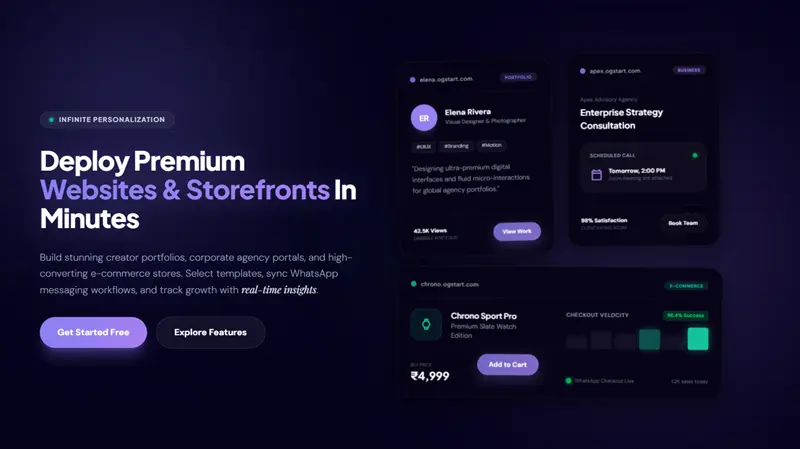
At OGStart, we empower you to Launch Premium Websites & Storefronts - OGStart for as little as INR 99, allowing you to validate your ideas affordably and upgrade only when your business truly grows. But once your site is live, how do you attract those crucial first visitors? The answer lies in Search Engine Optimization (SEO). SEO isn't just for big brands with massive budgets; it's a fundamental strategy for every new online venture aiming for sustainable growth.
This comprehensive guide will break down 10 foundational SEO hacks designed to help your new online presence – be it a Shopify store, an OGStart-powered site, or any other platform – not just gain traffic, but aim for a top ranking by 2026. We systematically analyzed common pitfalls and successful strategies for nascent businesses. Our goal is to provide clear, actionable insights in simple English, ensuring even non-technical founders can confidently implement these techniques.
The Critical Role of SEO for New Online Businesses
Imagine opening a beautiful physical store in a bustling city, but no one knows it exists. That’s often the reality for new websites without SEO. Search engines like Google are the primary way potential customers discover new products, services, and information. Ranking high in search results means your business gets seen by people actively looking for what you offer. Without it, you’re relying on word-of-mouth or paid advertising, which can be expensive and unsustainable in the long run.
For businesses that start small and need to launch fast, like those leveraging OGStart’s affordable platform, SEO is not an optional extra; it’s a core component of your initial strategy. It builds credibility, drives organic (free) traffic, and establishes your online authority over time. Don’t pay like a big brand on day one for traffic; invest in SEO to earn it.
Demystifying SEO for First-Timers: What You Need to Know
SEO can seem complex, filled with jargon and constantly evolving algorithms. However, at its core, SEO is about making your website useful and understandable to both search engines and human users. Search engines want to provide the most relevant and high-quality results for any given query. Your job is to signal to them that your site is precisely that.
Here are the fundamental pillars of SEO that we will focus on:
- Keywords: The words and phrases people type into search engines.
- On-Page SEO: Optimizing content and HTML source code of a page.
- Technical SEO: Ensuring search engines can easily crawl, index, and render your site.
- Content: Creating valuable, relevant information for your audience.
- Off-Page SEO: Activities outside your website that influence rankings (e.g., backlinks).
- User Experience (UX): How easy and pleasant your site is to navigate.
Let's dive into the 10 foundational SEO hacks that can put your new business on the path to ranking #1.
1. Master Keyword Research: Speak Your Audience’s Language
The first step in any successful SEO strategy is understanding what your potential customers are searching for. This isn't about guessing; it's about research.
- Identify "Seed" Keywords: Start with broad terms related to your product or service. If you sell handmade jewelry, "handmade jewelry" is a seed.
- Explore Long-Tail Keywords: These are longer, more specific phrases (e.g., "unique silver pendant necklaces for women"). They have lower search volume but much higher conversion potential because the user’s intent is clearer. They are also easier for new sites to rank for.
- Analyze Competitors: See what keywords your successful competitors are ranking for. Tools like Ahrefs, SEMrush, or even Google’s "People also ask" section can reveal valuable insights.
- Utilize Free Tools: Google Keyword Planner (requires a Google Ads account, but doesn't need active campaigns), Ubersuggest, and AnswerThePublic are excellent starting points.
- Focus on User Intent: Is the user looking to buy (transactional), learn (informational), or navigate (navigational)? Tailor your content to match this intent.
By understanding and strategically using these keywords, you tell search engines exactly what your pages are about, increasing your chances of appearing in relevant searches.
2. Optimize On-Page Elements: Make Every Page Count
Once you have your keywords, integrate them naturally into your website’s pages. On-page SEO involves optimizing individual web pages to rank higher and earn more relevant traffic in search engines.
- Title Tags: The most critical on-page element. Include your primary keyword near the beginning, keep it concise (under 60 characters), and make it compelling.
- Meta Descriptions: While not a direct ranking factor, a well-written meta description acts as an advertisement for your page in search results, encouraging clicks. Include your keyword and a compelling call to action.
- Header Tags (H1, H2, H3): Use H1 for your main page title. Use H2s and H3s to break up your content and structure it logically. Naturally include keywords in these headings.
- Content Quality and Depth: Your content must be high-quality, comprehensive, and valuable to the user. Aim for depth rather than just keyword stuffing. Google values content that genuinely answers user questions and provides solutions.
- Image Optimization: Use descriptive filenames and "alt text" for all images. Alt text helps search engines understand what the image is about and improves accessibility.
- URL Structure: Create short, keyword-rich, and descriptive URLs (e.g., yourdomain.com/product/blue-widget instead of yourdomain.com/p?id=123). OGStart helps ensure clean URL structures for your sites.
3. Prioritize Technical SEO Basics: Laying a Strong Foundation
Technical SEO ensures that search engines can efficiently crawl, index, and understand your website. This is particularly crucial for new sites that need to establish their presence quickly.
- Mobile-Friendliness: A non-negotiable in today's mobile-first world. Your website must be responsive and provide an excellent experience on all devices. Google heavily penalizes non-mobile-friendly sites.
- Site Speed: Users and search engines alike prefer fast-loading websites. Optimize images, leverage browser caching, and use a reliable hosting provider. OGStart handles hosting and platform infrastructure, ensuring a fast and scalable experience for your users. We systematically analyzed core web vitals and implemented solutions to optimize performance across all sites hosted on our platform.
- SSL Certificate (HTTPS): Essential for security and a minor ranking factor. If your site URL starts with HTTPS, you're good. Most reputable platforms, including OGStart, automatically provide this.
- XML Sitemap: A map of all important pages on your site that you want search engines to crawl. Submit it to Google Search Console.
- Robots.txt File: A file that tells search engines which pages or sections of your site they should or shouldn't crawl. Use it carefully to prevent indexing of unimportant pages.
4. Create High-Quality, Engaging Content: Be the Authority
Content is king – a saying that remains true in SEO. To rank #1, you need to provide content that truly stands out. This goes beyond just text; it includes images, videos, infographics, and interactive elements.
- Solve Problems: Create content that addresses your audience's pain points, answers their questions, and provides solutions.
- Be Comprehensive: If you’re writing about a topic, aim to be the most thorough resource available. Cover all angles.
- Show, Don’t Just Tell: Use examples, case studies, and practical guides. For an e-commerce store, high-quality product descriptions and compelling imagery are vital.
- Consistency is Key: Regularly publish new, fresh content. This signals to search engines that your site is active and a valuable resource. Consider a blog section – many OGStart users leverage this feature to share insights and build authority. You can find inspiration and guidance in our Resources & Insights - OGStart.
- Originality: Avoid duplicating content from other sites. Google rewards unique perspectives and original research.
5. Implement Local SEO Strategies: Dominate Your Neighborhood
If your business serves a specific geographical area (e.g., a local bakery, a salon, a consultancy), local SEO is paramount.
- Google My Business (GMB): This is non-negotiable. Claim and optimize your GMB profile with accurate business information (Name, Address, Phone Number – NAP), photos, services, and business hours. Encourage customer reviews.
- Local Citations: Ensure your NAP information is consistent across all online directories (Yelp, Yellow Pages, etc.). Inconsistencies can confuse search engines.
- Geo-Targeted Keywords: Include your city or region in your keywords (e.g., "best coffee shop Delhi").
- Local Content: Create blog posts or pages about local events, community initiatives, or specific local services you offer.
Local SEO can provide a significant advantage for new businesses, allowing them to compete effectively against larger entities in their specific market.
6. Build High-Quality Backlinks: Earn Trust and Authority
Backlinks (links from other websites to yours) are one of the strongest ranking signals. They act as "votes of confidence" from other sites, telling search engines that your content is valuable and trustworthy. Not all backlinks are equal; quality trumps quantity.
- Create "Linkable Assets": Develop exceptionally valuable content (e.g., original research, in-depth guides, compelling infographics) that other websites will naturally want to link to.
- Guest Blogging: Write articles for other reputable websites in your industry and include a link back to your site.
- Broken Link Building: Find broken links on other websites, suggest your relevant content as a replacement.
- Competitor Backlink Analysis: Use tools to see where your competitors are getting their links from and try to replicate those opportunities.
- Avoid Black-Hat Tactics: Never buy links or engage in spammy link schemes. This can lead to severe penalties from Google.
Building high-quality backlinks is a long-term strategy that requires effort and relationship-building, but its impact on your ranking potential is immense.
7. Optimize User Experience (UX): Keep Visitors Happy
Google increasingly prioritizes user experience. If users land on your site and quickly leave (high bounce rate), or struggle to find what they need, it signals to Google that your site isn't providing a good experience. This can negatively impact your rankings.
- Intuitive Navigation: Make it easy for users to find what they're looking for with clear menus, logical categories, and a prominent search bar.
- Readability: Use clear fonts, sufficient font size, ample white space, and short paragraphs. Break up text with headings, subheadings, and bullet points.
- Clear Calls to Action (CTAs): Guide users towards desired actions (e.g., "Buy Now," "Contact Us," "Learn More").
- Minimize Distractions: Avoid excessive pop-ups or intrusive ads, especially on mobile.
- Accessibility: Ensure your site is usable for people with disabilities. This includes proper alt text for images, keyboard navigation, and clear color contrast.
8. Embrace Mobile-First Indexing: Design for the Small Screen
Google now primarily uses the mobile version of your content for indexing and ranking. This means if your mobile site is subpar, it will affect your overall search performance, even for desktop users.
- Responsive Design: Your website should automatically adjust its layout and content to fit any screen size. This is a standard feature in modern website builders like OGStart.
- Mobile Speed: Just like desktop, mobile speed is crucial. Test your mobile site speed using tools like Google's PageSpeed Insights.
- Easy Navigation on Mobile: Ensure menus are easy to tap, buttons are sufficiently sized, and text is readable without zooming.
- Avoid Intrusive Interstitials: Pop-ups that block mobile content can lead to penalties.
9. Monitor and Analyze with Google Analytics and Search Console
Launching your website and implementing these hacks is just the beginning. To truly rank #1, you need to continuously monitor your performance and adapt your strategy.
- Google Analytics: Track visitor behavior – where they come from, which pages they visit, how long they stay, and their bounce rate. This data provides invaluable insights into what's working and what isn't.
- Google Search Console (GSC): This is your direct line to Google. GSC helps you monitor your site's search performance, identify indexing issues, see which queries you rank for, and discover manual actions or security issues.
- Regular Audits: Periodically conduct SEO audits to identify technical issues, broken links, thin content, and opportunities for improvement.
We systematically analyzed the impact of data-driven decisions on growth. Without these tools, you are essentially flying blind. Leverage them to refine your strategy and improve outcomes.
| Feature | Reactive SEO (Common for New Founders) | Proactive SEO (Recommended for #1 Ranking) |
|---|---|---|
| Keyword Research | Minimal or based on intuition; focus on obvious terms. | In-depth analysis of long-tail, competitor, and intent-based keywords. |
| Content Creation | Sparse, brief, or product-centric; focus on sales. | Comprehensive, valuable, problem-solving, and regularly updated. |
| Technical SEO | Often overlooked; reliance on platform defaults. | Conscious effort for mobile-friendliness, speed, SSL, sitemaps. |
| Backlink Strategy | Non-existent or reliance on spammy tactics. | Strategic outreach, guest posting, creating linkable assets. |
| Monitoring & Analytics | Infrequent checks; lack of understanding of metrics. | Consistent use of Google Analytics/GSC for data-driven adjustments. |
| Time to See Results | Often frustratingly slow or none; perceived as "SEO doesn't work." | Steady, sustained growth over several months to a year. |
10. Cultivate Patience and Persistence: SEO is a Marathon
Perhaps the most challenging hack of all – SEO takes time. Google's algorithms are designed to reward sustained effort and genuine value. Don't expect to implement these 10 hacks and see instant #1 rankings overnight.
- Expect a Lag: It can take anywhere from a few months to over a year for a new website to gain significant traction and rank for competitive keywords.
- Consistency Wins: Continuously creating quality content, building legitimate links, and optimizing your site will yield results.
- Adapt and Learn: The SEO landscape is constantly evolving. Stay updated with industry news and Google's algorithm changes. Resources like Search Engine Land or Google's official SEO blog are excellent for this.
- Focus on the User: Ultimately, Google wants to provide the best experience for its users. If you consistently focus on delivering value to your audience, search engines will reward you.
Beyond the Basics: Preparing for Future SEO Success
As you progress, consider delving into more advanced topics. Voice search optimization, schema markup (structured data), and leveraging AI for content creation or analysis are all becoming increasingly important. However, these 10 foundational hacks are the bedrock upon which all future success will be built.
It's important to remember that while platforms like Shopify provide robust e-commerce tools, and OGStart offers an incredibly affordable starting point for various online ventures, the underlying SEO principles remain constant. Whether you're building a simple online presence or an elaborate store, the effort you put into SEO directly correlates with your visibility and growth.
While OGStart handles hosting, platform infrastructure, website/store management, and scaling, the responsibility for your domain purchase and connection lies with you. However, our platform is designed to make these technical integrations straightforward, allowing you to focus on your business and its growth. You may start with an OGStart subdomain and connect a custom domain later, providing maximum flexibility.
Your Journey to Online Visibility Starts Now
Launching a business online for INR 99 allows you to start small, launch fast, and validate your ideas without prohibitive upfront costs. But to truly thrive, you need to ensure your potential customers can find you. These 10 SEO hacks provide a robust roadmap for achieving significant online visibility and aiming for that coveted #1 ranking by 2026.
Don't pay like a big brand on day one; invest your time and effort in smart SEO strategies. Upgrade only when growth demands it, secure in the knowledge that your online foundation is strong. For further insights into establishing your online authority and growth, we recommend exploring resources on Google's own Search Central Blog, which provides official guidance on SEO best practices. Additionally, the Google Search Documentation offers deep technical insights into how search works, which can inform your strategy.
We are confident that by diligently applying these principles, your new online venture will not only attract its first visitors but will build a sustainable pathway to long-term success in the digital realm. Begin your journey today and watch your business grow.