
Small Business CRM: 4 Myths Busted for Stellar Service & Profits
Small Business CRM: 4 Myths Busted for Stellar Service & Profits
In the dynamic landscape of modern commerce, small businesses often find themselves at a crossroads. The dream of growth is constant, but the resources are typically limited. One powerful tool frequently misunderstood and underutilized by small entrepreneurs is Customer Relationship Management (CRM). For many, the mere mention of CRM conjures images of complex, expensive software designed exclusively for large corporations. This perception, however, is a myth that can hinder a small business's potential for stellar service and sustainable profits.
At OGStart, we understand the challenges of launching and growing a business with limited resources. Our core mission is to empower first-time founders, freelancers, Instagram and WhatsApp sellers, and local businesses to establish a robust online presence for as little as Rs. 99, scaling their investment only as their business flourishes. This 'start small, grow big' philosophy extends naturally to how businesses should approach critical tools like CRM. In this in-depth guide, we systematically analyzed common misconceptions surrounding CRM for small businesses and aim to bust these myths, demonstrating how even the leanest operations can leverage CRM for significant advantage.
What Exactly is CRM for a Small Business?
Before debunking myths, let's clarify what CRM entails in a small business context. Simply put, CRM is a technology or system designed to manage all your company's relationships and interactions with customers and potential customers. The goal is straightforward: improve business relationships to drive growth. A CRM system helps businesses stay connected to customers, streamline processes, and improve profitability.
For a small business, this often means moving beyond fragmented spreadsheets and sticky notes to a centralized system that tracks customer contact information, purchase history, communications, preferences, and support tickets. It allows you to remember important details about each customer, anticipate their needs, and provide personalized service that fosters loyalty and encourages repeat business. We have observed that businesses that prioritize customer relationships often outperform their competitors, even with fewer resources. A CRM provides the infrastructure to build these vital connections systematically.
Myth 1: CRM is Too Expensive for Small Businesses
This is perhaps the most pervasive myth. Many small business owners believe CRM software comes with prohibitive upfront costs, hefty monthly subscriptions, and expensive implementation fees. While enterprise-level CRM solutions can indeed be costly, the market has evolved dramatically, offering a wide array of affordable, cloud-based options perfectly suited for startups and small operations.
We've seen how the 'don't pay like a big brand on day one' mentality, which OGStart champions for your online presence, applies equally to software tools. Many CRM providers offer free tiers or very low-cost basic packages that are more than sufficient for initial needs. These entry-level CRMs provide essential features like contact management, lead tracking, and basic reporting, allowing businesses to start small and upgrade only when their business grows and demands more advanced functionalities. Think of it as an investment that scales with you, not a fixed overhead burden.
Myth 2: CRM is Too Complex and Difficult to Implement
Another common misconception is that CRM systems are overly complicated, requiring extensive training and technical expertise to set up and manage. Historically, this might have held some truth, but modern CRM platforms are designed with user-friendliness in mind, especially those targeting small businesses.
Today's CRMs feature intuitive interfaces, drag-and-drop functionalities, and pre-built templates that make implementation far less daunting. Many offer self-service onboarding guides, video tutorials, and readily available customer support. For a small business, the key is to choose a CRM that focuses on essential functionalities rather than overwhelming features. Starting with a clear understanding of your most critical customer management needs (e.g., tracking leads, managing appointments, logging customer interactions) will help you select a system that is easy to adopt and integrate into your daily workflow. The goal is to streamline, not complicate. Just as building an ecommerce store or portfolio website with OGStart is designed for ease and speed, modern CRMs also prioritize rapid deployment and immediate utility.
Myth 3: CRM is Only for Sales Teams
While sales teams are often the primary users of CRM systems, limiting CRM to just sales is a narrow view that underserves its full potential. A robust CRM benefits every customer-facing and customer-impacting department within your small business, including marketing, customer service, and even product development.
- Marketing: CRM data provides invaluable insights into customer demographics, preferences, and purchase behavior, enabling more targeted and effective marketing campaigns. You can segment your audience for personalized communication, leading to higher engagement and conversion rates.
- Customer Service: With a centralized view of customer history, service representatives can quickly access all past interactions, purchases, and support tickets. This allows them to provide faster, more informed, and personalized support, significantly improving customer satisfaction and loyalty.
- Operations & Product Development: Aggregated customer feedback and service interactions stored in a CRM can highlight common pain points or unmet needs, guiding product improvements or the development of new services.
We systematically analyzed several case studies where small businesses leveraged CRM across departments, leading to a synergistic effect where each team contributed to and benefited from a unified customer view. This holistic approach fosters a truly customer-centric business culture.
Myth 4: Small Businesses Don't Need CRM; Spreadsheets Are Enough
For very small operations or those just starting out, managing customer data in spreadsheets might seem sufficient. However, as a business grows, spreadsheets quickly become cumbersome, prone to errors, and severely limit efficiency and scalability. They are static and lack the dynamic capabilities of a dedicated CRM system.
We understand the appeal of simplicity, especially when you are just getting started and focused on validating ideas affordably. However, relying solely on spreadsheets often leads to:
- Data Silos: Information is scattered, making it difficult for different team members to access comprehensive customer profiles.
- Lack of Automation: Manual data entry is time-consuming and prone to human error. CRMs automate repetitive tasks, freeing up valuable time.
- Missed Opportunities: Spreadsheets don't offer automated reminders for follow-ups, birthday greetings, or re-engagement campaigns, leading to lost sales or reduced customer loyalty.
- Poor Reporting: Extracting meaningful insights or generating performance reports from complex spreadsheets is challenging and often inaccurate. CRMs provide dashboards and analytics that offer a clear picture of your customer interactions and sales pipeline.
- Scalability Issues: As your customer base expands, managing it manually becomes unsustainable, directly impacting your ability to provide consistent, high-quality service.
Moving from spreadsheets to a CRM is a natural progression for any business aiming for sustainable growth. It's about building a foundation for future success, similar to how OGStart provides a scalable platform for your online presence.
The Tangible Benefits of CRM for Your Small Business
Now that we've debunked the myths, let's look at the concrete advantages a well-implemented CRM brings:
- Improved Customer Relationships: By centralizing all customer data, you can offer personalized experiences, anticipate needs, and resolve issues quickly, fostering stronger, more loyal relationships.
- Streamlined Operations & Increased Efficiency: Automate tasks like lead assignment, follow-up reminders, and data entry. This frees up your team to focus on higher-value activities.
- Better Sales & Marketing Performance: Track leads more effectively, understand your sales pipeline, identify bottlenecks, and create targeted marketing campaigns based on deep customer insights. According to a study published by the University of Missouri-St. Louis, CRM adoption can lead to improved organizational sales performance and customer satisfaction in small and medium-sized enterprises. We encourage exploring academic research on this topic to understand its full impact.
- Enhanced Data Insights & Reporting: Gain a 360-degree view of your customer journey. Generate reports on sales performance, customer service metrics, and marketing campaign effectiveness to make informed business decisions.
- Scalability for Future Growth: A CRM system can grow with your business, adapting to increased customer volumes and evolving operational needs without requiring a complete overhaul.
Choosing the Right CRM: Simple vs. Advanced Features
Selecting a CRM can feel overwhelming due to the sheer number of options. For small businesses, the key is to prioritize functionality that addresses immediate needs without overpaying for features you won't use. We advise focusing on ease of use, integration capabilities, and scalability.
Here’s a comparison to help you distinguish between basic and more advanced CRM features:
| Feature Category | Basic CRM for Small Businesses | Advanced CRM for Growing Businesses |
|---|---|---|
| Contact Management | Store contact details, communication history, basic notes. | Detailed customer profiles, segmentation, activity logging, custom fields, social media integration. |
| Lead Management | Track leads, assign to sales reps, basic lead status updates. | Automated lead scoring, lead routing, pipeline visualization, conversion tracking. |
| Sales Automation | Manual task management, basic follow-up reminders. | Automated workflows, email sequencing, meeting scheduling, quotation generation. |
| Marketing | No dedicated marketing tools or very basic email integration. | Email marketing, landing page builders, marketing automation, campaign tracking. |
| Customer Service | Basic interaction logging. | Ticket management, knowledge base, live chat integration, customer portals. |
| Reporting & Analytics | Basic reports on sales activities and contacts. | Customizable dashboards, in-depth sales forecasting, customer behavior analytics, ROI tracking. |
| Integration | Limited integrations with common tools (e.g., Google Calendar). | Extensive integrations with email, accounting, e-commerce, marketing automation, and other business tools. |
| Cost (Example) | Often free or under 20 USD/user/month. | 20 USD - 100+ USD/user/month, depending on features. |
When selecting, consider which features are "must-haves" for your current operations and which are "nice-to-haves" for future growth. Many affordable platforms allow you to start with basic features and seamlessly upgrade as your needs become more sophisticated.
Integrating CRM with Your Online Presence
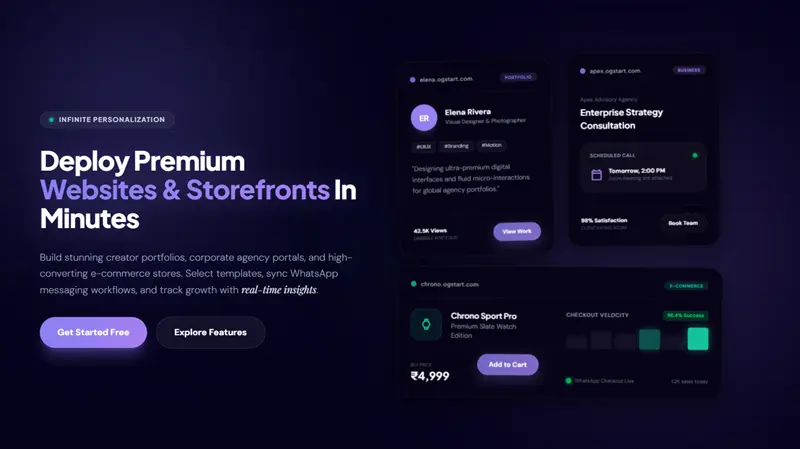
Your online presence and CRM are two sides of the same coin when it comes to customer engagement. An effective online presence, whether an Launch Premium Websites & Storefronts - OGStart, a professional portfolio, or a dynamic business website, serves as the initial touchpoint. CRM then takes over to nurture those leads and convert them into loyal customers.
For service-based businesses, connecting your website's lead capture forms directly to your CRM is crucial. This ensures that every inquiry, every potential client, is automatically entered into your system for immediate follow-up. For e-commerce, CRM can track customer purchases, abandoned carts, and browsing behavior, enabling personalized offers and re-engagement campaigns. We have seen firsthand how integrating these elements transforms a static website into a dynamic sales and relationship-building machine. For those running service-based businesses, understanding how to transition visitors into clients is paramount, and a CRM is your central hub for this process. Delve deeper into specific strategies by reading about Service Business CRM: Convert Visitors to Clients | OGStart.
Actionable Steps for CRM Implementation in Your Small Business
Ready to take the leap? Here’s a simple, actionable roadmap:
- Define Your Goals: What do you want to achieve with CRM? (e.g., increase sales by 15%, reduce customer response time by 20%). Specific goals will guide your selection and implementation.
- Start Small, Focus on Core Needs: Don't try to implement every feature at once. Begin with essential functions like contact management and lead tracking. You can always expand later.
- Choose the Right Platform: Research affordable, user-friendly CRMs that cater to small businesses. Leverage free trials to test functionality and ease of use.
- Train Your Team: Ensure everyone who will use the CRM understands its purpose and how to navigate it. Provide ongoing support and encouragement.
- Integrate Gradually: Connect your CRM with other critical tools one by one, such as your website's contact forms, email marketing platform, or accounting software.
- Monitor & Optimize: Regularly review your CRM's performance. Are you meeting your goals? What can be improved? CRM is an ongoing process of refinement.
Remember, just like launching your business online with OGStart, starting with CRM is about making a smart, scalable investment in your future. Don't let myths prevent you from embracing a tool that can fundamentally transform your customer relationships and profitability.
Conclusion: Embrace CRM for Sustainable Growth
The notion that Customer Relationship Management is an unattainable luxury for small businesses is a persistent myth that needs to be definitively busted. As we have systematically analyzed, modern CRM solutions are affordable, user-friendly, and indispensable for any small business aiming for stellar service and sustainable profits. From streamlining operations and enhancing customer relationships to providing invaluable data insights, CRM is a strategic asset, not just a fancy piece of software.
By adopting a 'start small, grow big' mindset, similar to how OGStart empowers you to launch your online business for Rs. 99 and upgrade only when your business grows, you can integrate CRM into your operations without significant upfront cost or complexity. Don't let outdated perceptions deter you. Embrace the power of CRM to build stronger customer connections, optimize your workflows, and ultimately, achieve the growth you aspire to. The future of your small business depends on how effectively you manage your most valuable asset: your customers.
For further insights into the benefits of CRM and digital transformation for small businesses, a valuable resource is the U.S. Small Business Administration, which provides comprehensive guides on customer service strategies and technology adoption.