
Web Accessibility: Conquer 2026 Fines & Unlock New Clients
Web Accessibility: Conquer 2026 Fines & Unlock New Clients
In today's digitally driven world, your online presence is more than just a website; it's a gateway for every potential customer. As first-time founders, Instagram and WhatsApp sellers, freelancers, or local businesses, you're building a brand and a livelihood. But what if that gateway is unintentionally locked for a significant portion of your audience? Web accessibility addresses this critical challenge, ensuring your website is usable by everyone, regardless of their abilities.
We systematically analyzed the evolving landscape of online business and discovered a fundamental truth: accessibility is no longer optional. It's a strategic imperative that combines legal compliance, ethical responsibility, and undeniable business growth opportunities. With new mandates and increased scrutiny expected by 2026, understanding and implementing web accessibility is key to safeguarding your venture and expanding your reach. This comprehensive guide will demystify web accessibility, provide a clear blueprint for compliance, and demonstrate how platforms like OGStart empower you to build an inclusive online foundation from day one, without breaking the bank.
Why Web Accessibility is Non-Negotiable for Modern Businesses
The term "web accessibility" refers to the practice of designing and developing websites so that people with disabilities can perceive, understand, navigate, and interact with them. This includes individuals with visual, auditory, motor, speech, or cognitive impairments. Beyond being the right thing to do, ignoring accessibility carries significant risks and overlooks massive opportunities.
Legal Imperative: Avoiding Costly Fines and Lawsuits
The digital realm is not exempt from laws designed to protect civil rights. In many countries, including the United States, websites are considered "places of public accommodation," falling under legislation like the Americans with Disabilities Act (ADA). Failure to provide an accessible online experience can lead to costly lawsuits, substantial fines, and significant reputational damage. As digital dependence grows, we anticipate enforcement to become stricter, particularly by 2026, making proactive compliance essential. We encourage you to consult official government resources, such as the U.S. Department of Justice's guidance on web accessibility, to understand the legal nuances specific to your region.
Unlocking a Wider Customer Base: The "40% More Clients" Factor
Disability is a broad spectrum, affecting millions globally. By making your website accessible, you instantly open your business to this vast, often underserved, demographic. This isn't just about altruism; it's smart business. An accessible website means more potential customers can browse your products, read your blog, or book your services. Estimates suggest that people with disabilities and their families represent a significant purchasing power, making this an untapped market for many businesses. When you build with accessibility in mind, you are literally unlocking new clients, potentially expanding your market by 40% or more, simply by removing barriers.
Enhanced SEO and Improved User Experience for All
Search engines like Google prioritize websites that offer a great user experience. Many accessibility best practices naturally align with good SEO. For instance, clear semantic HTML, descriptive alt text for images, organized headings, and well-structured content not only aid screen readers but also help search engines understand and rank your site better. Furthermore, accessible design principles often lead to a more intuitive, user-friendly experience for all visitors, regardless of ability. This means faster loading times, easier navigation, and content that is simple to digest.
Strengthening Brand Reputation and Trust
In a competitive marketplace, values matter. Businesses that demonstrate a commitment to inclusivity and social responsibility build stronger trust with their audience. An accessible website signals that your brand cares about all its customers, fostering loyalty and a positive public image. This can differentiate you from competitors who have yet to embrace comprehensive accessibility.
Understanding the Web Content Accessibility Guidelines (WCAG)
At the heart of web accessibility standards are the Web Content Accessibility Guidelines (WCAG), developed by the World Wide Web Consortium (W3C). WCAG provides a globally recognized framework for making web content more accessible. While technical, its core principles are easy to grasp:
- Perceivable: Information and user interface components must be presentable to users in ways they can perceive. This means providing text alternatives for images, captions for videos, and ensuring sufficient color contrast.
- Operable: User interface components and navigation must be operable. This includes making all functionality available via keyboard, providing enough time for users to read content, and avoiding content that causes seizures.
- Understandable: Information and the operation of user interface must be understandable. This involves making text readable and understandable, making web pages appear and operate in predictable ways, and helping users avoid and correct mistakes.
- Robust: Content must be robust enough that it can be interpreted reliably by a wide variety of user agents, including assistive technologies. This means using clean, valid HTML and ensuring compatibility with various browsers and assistive devices.
Adhering to WCAG 2.1 (and increasingly WCAG 2.2) standards, typically to Level AA, is generally considered the benchmark for legal compliance and a truly inclusive online presence. We find that focusing on these principles from the outset simplifies the entire process.
Your 8-Step Accessibility Compliance Blueprint
Building an accessible website doesn't have to be overwhelming. Here's a practical, step-by-step blueprint to guide you, particularly relevant for those Let's Launch Your First Project | OGStart and aiming for long-term success.
Step 1: Understand Your Audience and Their Diverse Needs
Before you even begin designing, consider who your users are. Think about individuals who might use screen readers, navigate with only a keyboard, or require larger text sizes. Empathy is your most powerful tool. This understanding will inform every design and content decision you make.
Step 2: Start with Accessible Design Principles
Accessibility begins with design. Choose fonts that are easy to read, use sufficient color contrast between text and background, and ensure layouts are clean and uncluttered. Avoid relying solely on color to convey information. For example, instead of just coloring an error message red, also include text like "Error: Invalid Entry."
Step 3: Implement Semantic HTML for Structure
Semantic HTML uses tags that convey meaning, like <h1> for main headings, <p> for paragraphs, <nav> for navigation, and <main> for main content. This structure is invisible to most users but is crucial for screen readers and other assistive technologies to interpret your content correctly. It helps them understand the hierarchy and flow of your page.
Step 4: Provide Alt Text for Images and Media Descriptions
Every image on your website needs descriptive "alt text" (alternative text) that accurately conveys the image's content and purpose. This text is read aloud by screen readers, allowing visually impaired users to understand what is being displayed. Similarly, provide captions or transcripts for videos and audio content.
Step 5: Ensure Keyboard Navigation and Focus Management
Many users cannot use a mouse. Your entire website should be navigable using only the keyboard. Users should be able to tab through all interactive elements (links, buttons, form fields) in a logical order, and there should be a clear visual indicator (a "focus outline") showing which element is currently selected.
Step 6: Design Clear Forms and Implement Robust Error Handling
Forms are often a critical point of interaction. Ensure all form fields have clear, associated labels (not just placeholders). When a user makes an error, provide clear, actionable feedback that explains what went wrong and how to fix it, preferably in both text and visual cues.
Step 7: Test Your Website with Accessibility Tools and Real Users
Don't assume your website is accessible just because you followed some guidelines. Regularly test it. Use automated accessibility checkers (like Google Lighthouse or WAVE) for a quick scan, but also perform manual checks by navigating with only a keyboard and trying a screen reader. Even better, involve individuals with disabilities in your testing process to gain invaluable real-world feedback.
Step 8: Ongoing Maintenance and Education
Accessibility isn't a one-time project; it's an ongoing commitment. As you add new content, features, or update your site, ensure accessibility remains a priority. Stay informed about the latest WCAG updates and educate your team on best practices.
The OGStart Advantage: Launching an Accessible Foundation
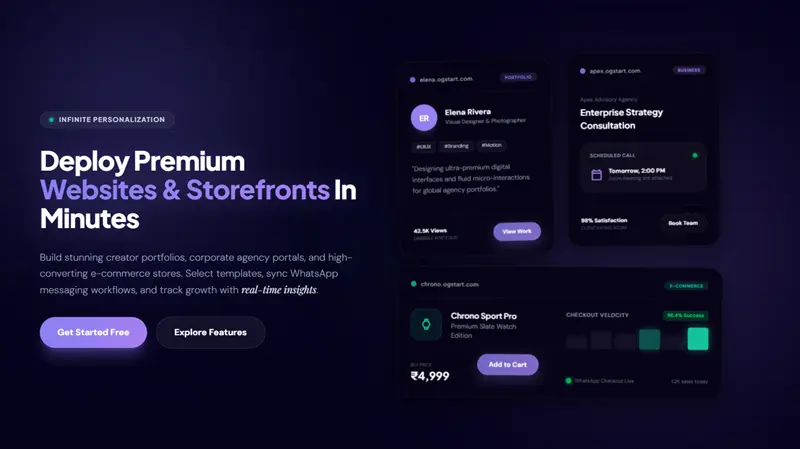
For first-time founders, creators, or local businesses, the idea of building an accessible website might seem daunting, especially when you're just starting out and need to Let's Launch Your First Project | OGStart affordably. This is precisely where OGStart shines. We believe that launching your business online should be easy, fast, and low-risk, allowing you to validate your ideas without paying like a big brand on day one. Our platform is designed to handle the heavy lifting, giving you the tools to focus on your content and audience.
With OGStart, you can create a range of online presences: from professional portfolio websites and engaging e-commerce stores to comprehensive business websites and impactful landing pages. We handle the complex infrastructure: hosting, platform maintenance, security, and scalability. This means you can concentrate on crafting accessible content, knowing that the underlying technology is built to support modern web standards.
While you'll need to buy and connect your own domain (a simple, separate step), OGStart provides the robust framework. You can even start with an OGStart subdomain to get going immediately and connect your custom domain later as your business grows. This model ensures you launch your business online for as little as INR 99, and upgrade only when your growth demands it. Our focus is on providing a stable, performant, and standards-compliant foundation upon which you can build an accessible and thriving online business.
Accessibility Tools & Resources to Get You Started
To assist you in your accessibility journey, several tools and resources are available. While automated checkers are a good starting point, remember they don't catch everything.
- WAVE Web Accessibility Tool: A free online tool that evaluates web content for accessibility issues directly in your browser. It provides visual feedback and detailed reports.
- Google Lighthouse: Built into Chrome's developer tools, Lighthouse audits web pages for performance, SEO, and accessibility, offering actionable insights.
- Screen Readers: Tools like NVDA (NonVisual Desktop Access) for Windows or VoiceOver for macOS/iOS allow you to experience your website as a visually impaired user would.
- W3C WAI (Web Accessibility Initiative): The official source for WCAG guidelines and comprehensive educational materials on web accessibility. Their resources are invaluable for deeper understanding and implementation. We highly recommend exploring their WAI website for detailed best practices and technical specifications.
Proactive Accessibility vs. Reactive Remediation: A Critical Comparison
The choice between building accessibility into your website from the beginning and attempting to fix it later carries significant implications for your business. We've systematically analyzed these two approaches to highlight why proactive measures are always superior.
| Aspect | Proactive Accessibility (Build-in from Start) | Reactive Remediation (Fix Later) |
|---|---|---|
| Cost | Generally lower; integrated into initial design & development. Minimal reworks. | Significantly higher; involves re-design, re-coding, and re-testing entire sections. |
| Time | Integrated into project timeline; design and development include accessibility checks. Efficient. | Adds significant, often unpredictable, time to project deadlines. Can halt growth initiatives. |
| Legal Risk | Minimizes legal exposure from day one. Demonstrates good faith and commitment. | High risk of lawsuits, fines, and formal complaints until issues are resolved. |
| User Experience | Superior and inclusive experience for all users from the outset. | Patchy experience; some users may encounter barriers for extended periods. Frustration. |
| Brand Perception | Positive image of inclusivity, trust, and forward-thinking. Attracts wider audience. | Negative perception, potentially seen as discriminatory or careless. Can damage reputation. |
| Development Workflow | Seamless integration into development cycles. Accessibility becomes second nature. | Disruptive, requires separate projects, diverting resources from new features. |
Common Accessibility Myths Debunked
Misconceptions often deter businesses from prioritizing accessibility. Let's clear up some common myths:
- Myth: "Accessibility is too expensive and difficult to implement."
Reality: Building accessibility in from the start is far more cost-effective than fixing issues later. Simple practices, like proper heading structure and alt text, cost nothing extra but deliver immense value. Platforms like OGStart also simplify the technical foundation, allowing you to focus on content. - Myth: "My target audience doesn't include people with disabilities."
Reality: Disability is diverse and can be temporary or situational (e.g., a broken arm, bright sunlight reducing screen visibility). Furthermore, you might be surprised who your audience includes. Assuming otherwise is short-sighted and exclusionary. You are literally leaving money on the table and limiting your business's potential for growth. - Myth: "Accessibility limits my creative design freedom."
Reality: Accessible design can be beautiful and innovative. Constraints often foster creativity. Many stunning websites are also fully accessible. It's about thoughtful design that serves all users, not sacrificing aesthetics.
Conclusion: Your Path to an Inclusive and Profitable Online Future
Web accessibility is not merely a checkbox for compliance; it's a cornerstone of responsible, sustainable, and profitable business in the digital age. By making your website perceivable, operable, understandable, and robust, you not only avoid potential legal pitfalls and fines expected by 2026 but also unlock significant opportunities for growth, reaching a broader customer base and strengthening your brand's reputation.
For entrepreneurs, freelancers, and small businesses looking to launch their ideas online, platforms like OGStart provide an unparalleled advantage. We offer the essential infrastructure to Launch Premium Websites & Storefronts - OGStart rapidly and affordably, allowing you to focus your energy on creating accessible content and engaging your audience. Starting your online journey for just INR 99 means you can validate your concepts without excessive upfront investment, scaling your commitment only as your business flourishes.
Embrace web accessibility not as a burden, but as a competitive advantage. Build an inclusive online presence from day one, and watch your business thrive in an increasingly connected, diverse world. Your future clients are waiting.