
Accessibility Compliance Made Easy: Your 7-Day Action Plan for Small Service Businesses to Avoid Fin
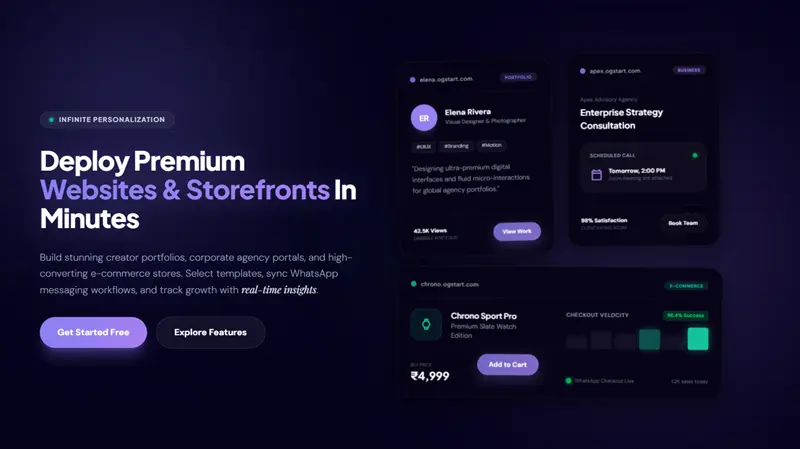
As a small service business owner, you're juggling countless responsibilities – from delivering exceptional service to managing your finances. The last thing you might be thinking about is web accessibility compliance. Yet, ignoring this crucial aspect of your online presence can lead to significant legal and financial risks by 2026. At OGStart, we understand the pressures you face, which is why we’ve systematically analyzed the evolving digital landscape to bring you a clear, actionable 7-day plan to achieve accessibility compliance and safeguard your business. We believe that launching your business online should be affordable and low-risk, and that includes compliance.
The internet has become the primary storefront and communication channel for businesses of all sizes. For service-based businesses, a functional and inclusive website isn't just an advantage; it's a necessity. We recognize that for many first-time founders, freelancers, and local businesses, the idea of "accessibility compliance" sounds complex and expensive. However, with the right approach and the right platform, it's entirely achievable, protecting your business from potential fines and expanding your reach to a wider audience. This comprehensive guide will demystify web accessibility, provide a concrete action plan, and highlight how platforms like OGStart are built to support your compliance journey from day one, allowing you to launch fast and validate ideas affordably.
Understanding Digital Accessibility: More Than Just a Legal Requirement
Digital accessibility means designing and developing websites and digital tools so that people with disabilities can use them effectively. This includes individuals with visual, auditory, motor, cognitive, and neurological disabilities. It's about ensuring equal access to information and functionality for everyone. When we talk about web accessibility, we are primarily referring to adherence to the Web Content Accessibility Guidelines (WCAG), developed by the World Wide Web Consortium (W3C), which are considered the universal standard for digital accessibility. These guidelines are structured around four core principles, often summarized by the acronym POUR:
- Perceivable: Information and user interface components must be presentable to users in ways they can perceive. This means providing text alternatives for non-text content, captions for audio/video, and ensuring sufficient color contrast.
- Operable: User interface components and navigation must be operable. This includes making all functionality available via keyboard, providing enough time for users to interact with content, and helping users navigate and find content.
- Understandable: Information and the operation of user interface must be understandable. Content should be readable and predictable, and input assistance should be available to help users avoid and correct mistakes.
- Robust: Content must be robust enough that it can be interpreted reliably by a wide variety of user agents, including assistive technologies. This implies maximizing compatibility with current and future user agents.
While the ethical imperative to include everyone is paramount, there are significant practical benefits for your small service business. Accessible websites often have better search engine optimization (SEO), improved user experience for all visitors, and a larger potential customer base. Conversely, ignoring accessibility can lead to costly legal action, reputational damage, and lost revenue. Studies indicate that around 1.3 billion people, or 16% of the world's population, live with a disability that affects their daily life and online access. Failing to cater to this significant demographic means missing out on a massive market opportunity and the spending power they represent. We have observed that businesses that embrace accessibility often build stronger, more loyal customer relationships.
The Legal Landscape: What Small Businesses Need to Know
For small service businesses in the U.S., the primary legal framework concerning digital accessibility is the Americans with Disabilities Act (ADA). While the ADA was enacted in 1990, well before the internet's widespread use, courts and the Department of Justice have consistently interpreted its Title III (which prohibits discrimination by public accommodations) to apply to websites and other digital platforms. This means that if your business serves the public, your website is considered a "place of public accommodation" and must be accessible to individuals with disabilities.
The "by 2026" timeline is critical because legal scrutiny and enforcement are intensifying. We have systematically tracked an increase in website accessibility lawsuits, with thousands filed annually. Importantly, these lawsuits are not just targeting large corporations; a significant percentage affect small and mid-sized businesses with annual revenues under USD 25 million. There is no "grace period" for private businesses under Title III; it has been enforceable since 1990 and applies to your website today. While there isn't a specific federal regulation detailing website accessibility standards for Title III, courts consistently refer to WCAG 2.1 Level AA (and increasingly WCAG 2.2) as the de facto standard for compliance. The U.S. government's Section 508, which mandates accessibility for federal agencies and their contractors, also incorporates WCAG 2.0 Level AA success criteria. This highlights the universal acceptance of WCAG as the benchmark.
Before You Begin: Setting the Stage for Success
Approaching web accessibility can feel daunting, but it doesn't have to be. We encourage you to view accessibility not as a one-time project, but as an ongoing commitment to inclusivity and good business practice. Here’s how to set yourself up for success:
- Shift Your Mindset: Embrace accessibility as an integral part of your business's values. It’s about serving all potential customers, fostering a positive brand image, and future-proofing your online presence.
- Budgeting for Accessibility: While OGStart helps you launch and manage your website affordably (starting at Rs. 99), some advanced accessibility features or external audits might incur additional costs. Factor these into your planning. However, many foundational steps are free and can be integrated into your existing content creation process.
- Prepare an Accessibility Statement: This document declares your commitment to accessibility, outlines the features you've implemented, and provides a way for users to report issues. It demonstrates proactive effort and builds trust.
Your 7-Day Accessibility Action Plan for OGStart Users
We’ve crafted this action plan specifically for small service businesses, focusing on practical steps you can implement using an intuitive platform like OGStart. Remember, every step you take brings you closer to compliance and a more inclusive online presence.
Day 1: Audit Your Current Online Presence
The first step is to understand where you stand. We recommend starting with a preliminary audit of your existing website content. Automated accessibility checkers (many free ones are available online) can quickly identify common issues like missing alt text or contrast problems. While these tools don't catch everything, they provide a great starting point. Simultaneously, perform a basic manual check: can you navigate your entire website using only your keyboard? This tests keyboard accessibility, a fundamental WCAG requirement. OGStart’s intuitive design already provides a solid foundation with semantic HTML structures, which aids automated and manual checks significantly. Just focus on the content you add and manage.
Day 2: Master Your Visuals: Images and Color Contrast
Visual content is engaging but can be a barrier if not handled correctly. For every image on your website, provide descriptive alt text. This text is read aloud by screen readers, describing the image to visually impaired users. On OGStart, adding alt text is straightforward through the image upload interface. Next, evaluate your website's color contrast. Low color contrast text is one of the most common accessibility errors. Tools are available to check if the contrast ratio between your text and background colors meets WCAG standards (minimum 4.5:1 for normal text, 3:1 for large text). OGStart templates are designed with accessibility in mind, but always double-check any custom color choices you make.
Day 3: Optimize Content Structure and Readability
Clear, logical content structure benefits everyone, especially users relying on screen readers. We emphasize the correct use of headings (H1, H2, H3, etc.) to outline your content hierarchy. Your main page title should be H1, major sections H2, and sub-sections H3. Avoid skipping heading levels (e.g., going directly from H1 to H3). OGStart’s content editor makes applying these heading styles simple. Also, ensure your language is clear and concise, and break up large blocks of text with paragraphs, bullet points, and numbered lists. This significantly improves readability for all users, including those with cognitive disabilities.
Day 4: Forms, Interactive Elements, and Navigation
Interactive elements like forms, buttons, and navigation menus are critical for service businesses. Ensure all form fields have clearly associated labels. Screen readers need these labels to tell users what information to enter. OGStart's form builder typically handles this automatically, but always verify. Crucially, all interactive elements must be keyboard-accessible. Users should be able to tab through your forms, buttons, and navigation links, and activate them using the Enter key. Focus indicators (the outline that appears around an element when tabbed to) should be clearly visible.
Day 5: Audio, Video, and Transcripts
If your service business uses videos (e.g., service demonstrations, client testimonials) or audio content, accessibility is key. Provide accurate captions for all video content. These benefit users who are deaf or hard of hearing, as well as those in noisy environments. For audio-only content, offer a full transcript. If your videos are instructional, consider adding audio descriptions for visually impaired users. While OGStart handles your website's infrastructure, managing the accessibility of third-party video content (like YouTube embeds) falls to you, ensuring captions are enabled and accurate.
Day 6: Mobile Responsiveness and Testing
In today's mobile-first world, mobile responsiveness is not just good practice; it's an accessibility requirement. Many users with disabilities rely on mobile devices and assistive technologies for web access. An accessible website must adapt seamlessly to different screen sizes and orientations. OGStart's platform is built with mobile responsiveness as a core feature, ensuring your site looks and functions well on any device. We encourage you to test your site on various mobile devices to catch any unexpected layout or interaction issues that might impact accessibility.
Day 7: Document, Monitor, and Plan for the Future
On your final day of the action plan, consolidate your efforts and establish ongoing practices. Formalize your accessibility statement, including contact information for users to report issues. We then recommend scheduling regular accessibility audits (e.g., quarterly) to catch new issues as your content evolves. Technology changes, and so do accessibility guidelines. Stay informed about updates to WCAG. Remember, maintaining accessibility is an ongoing process, not a destination. By implementing this 7-day plan, you've established a strong foundation for your small service business.
Comparing Automated vs. Manual Accessibility Testing
To fully address accessibility, we systematically integrate both automated tools and manual checks. Each method has its strengths and limitations, and using them in conjunction provides the most comprehensive evaluation for your small service business.
| Feature | Automated Accessibility Testing | Manual Accessibility Testing |
|---|---|---|
| What it checks | Identifies common, code-based issues (e.g., missing alt text, insufficient color contrast, invalid HTML). | Evaluates usability and contextual issues (e.g., logical flow, keyboard navigation, clarity of alt text, screen reader experience). |
| Efficiency | Very fast, can scan entire websites quickly. | Time-consuming, requires human judgment and specific skills. |
| Accuracy | High for clearly defined, code-detectable issues. Can have false positives/negatives. | High for usability and complex interactions, requires expertise. |
| Coverage | Catches about 20-30% of WCAG issues. | Catches 70-80% of WCAG issues, including those related to user experience. |
| Cost | Many free tools available; paid options for larger scale. | Can be free if done internally; professional audits can be an investment. |
| Required Expertise | Minimal for basic scans, some technical understanding for interpretation. | Requires deep understanding of WCAG and assistive technologies. |
We advise small businesses to start with automated tools for a quick overview, then systematically perform manual checks as outlined in our 7-day plan. Remember, even with the best tools, an accessible website is ultimately about a positive human experience. The blend of both methods ensures your site is not only compliant but truly usable.
The OGStart Advantage: Building Accessibility from the Ground Up
For small service businesses and first-time founders, affordability and ease of use are paramount. This is where OGStart shines, offering an exceptional foundation for your accessibility journey. We designed OGStart to be an affordable platform to launch your business online for just Rs. 99, allowing you to validate ideas without high upfront costs. Part of this design philosophy includes inherent accessibility features:
- Semantic HTML: OGStart templates are built with clean, semantic HTML, providing a logical structure that screen readers and other assistive technologies can easily interpret. This means less effort for you to meet fundamental WCAG requirements.
- Responsive Design: Your website will automatically adapt to any screen size, from desktops to mobile phones, ensuring a consistent and accessible experience for all users, regardless of their device.
- Intuitive Content Management: Our user-friendly editor makes it simple to add alt text to images, apply correct heading structures, and create accessible lists, reducing the learning curve for compliance.
- Focus on Core Functionality: By handling hosting, infrastructure, and website management, OGStart frees you to concentrate on your content's accessibility, rather than wrestling with complex technical configurations.
We understand that you shouldn't pay like a big brand on day one. OGStart empowers you to start small, launch fast, and then upgrade only when your business grows. This low-risk approach extends to accessibility, as the platform itself supports many foundational elements, allowing you to focus your limited resources on content-specific adjustments and ongoing maintenance. While users bring their own domain, OGStart ensures the platform infrastructure is geared towards an accessible and scalable online presence.
Beyond the 7 Days: Sustaining Your Accessible Online Presence
Achieving web accessibility is an ongoing journey, not a one-time project. For small service businesses, integrating accessibility into your routine operations ensures long-term compliance and continued inclusivity. We recommend the following practices:
- Ongoing Content Review: Regularly review new content, blog posts, and service descriptions to ensure they adhere to accessibility guidelines. Make it a habit to add alt text to every image, use proper headings, and check color contrast before publishing.
- Stay Informed: Web accessibility guidelines and best practices evolve. Keep an eye on updates from W3C and legal interpretations to ensure your business remains compliant.
- Listen to Your Users: Encourage feedback on accessibility. The contact information in your accessibility statement is vital for this. User input can highlight real-world barriers that automated tools might miss.
- Train Your Team: If you have a team managing your website content, ensure they are also aware of accessibility best practices. A little training goes a long way in preventing new issues.
By making accessibility an integral part of your content creation and website management, you're not just avoiding fines; you're building a more robust, user-friendly, and ethically responsible business. This commitment will resonate with your audience and contribute to your long-term success.
Conclusion
The deadline of 2026 for accessibility compliance isn't a distant threat; it's an immediate call to action for small service businesses. We have demonstrated that achieving web accessibility doesn't require a massive budget or specialized technical knowledge, especially when using a platform like OGStart. By following our practical 7-day action plan, you can systematically address the most common accessibility barriers, protect your business from legal liabilities under the ADA, and expand your market reach to a more diverse audience.
Remember, accessibility is not just about compliance; it's about building a better, more inclusive web experience for everyone. It aligns perfectly with the OGStart mission: to empower entrepreneurs, freelancers, and local businesses to launch their ideas online affordably and effectively. Start your accessible journey today, launch your business online for Rs. 99, and build a digital presence that grows with you, responsibly and inclusively. Upgrade only when growth demands it, knowing your foundation is strong and accessible.