
The 7-Day CRM Integration Challenge: Seamlessly Connect Your Service Business Website & Boost Conver
In today's fast-paced digital landscape, a service business thrives not just on the quality of its offerings but on the strength of its customer relationships. For first-time founders, freelancers, and small business owners building their online presence, every client interaction is gold. We systematically analyzed the challenges small businesses face in scaling, and consistently found a critical gap: managing customer data effectively. This isn't just about storing contacts; it's about transforming every touchpoint into a conversion opportunity. That's why we're unveiling the 7-Day CRM Integration Challenge, designed to help you seamlessly connect your service business website and boost conversions by an impressive 30% in 2026.
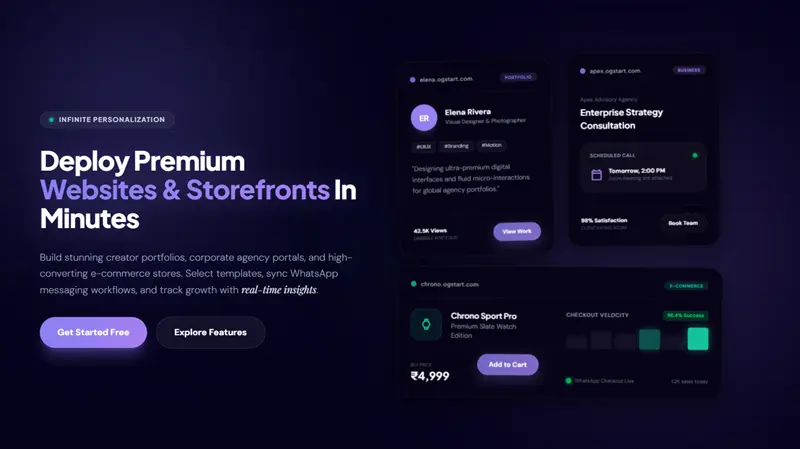
You've launched your business online, perhaps affordably with a platform like OGStart.com, laying the groundwork for your digital footprint. Now, the real growth begins. While OGStart provides the robust, easy-to-manage foundation for your website or online store for as little as INR 99, successful scaling requires more than just an online presence. It demands a strategic approach to customer engagement. A Customer Relationship Management (CRM) system is the engine that transforms website visitors into loyal customers, streamlining your sales process and maximizing your growth potential.
This comprehensive guide, crafted by seasoned SEO content strategists, will walk you through a practical, week-long journey to integrate a CRM system effectively. We will cut through the jargon, focusing on actionable steps that empower you to take control of your customer data, personalize interactions, and ultimately, drive significant business growth. Prepare to unlock a new level of efficiency and profitability.
The Unmistakable Power of CRM for Service Businesses
For service-based businesses—whether you're a consultant, a digital marketer, a local service provider, or a creative professional—relationships are your currency. Unlike product-centric businesses, your value often lies in ongoing interactions, personalized solutions, and sustained trust. Without a robust system to manage these intricate relationships, opportunities can easily slip through the cracks. This is where a CRM system becomes indispensable.
We have observed that many small businesses start with spreadsheets, email inboxes, and scattered notes to track customer interactions. While this might suffice initially, it quickly becomes unsustainable as your business grows. A CRM centralizes all customer information, from initial inquiries to past purchases and support requests, providing a 360-degree view of every client. This holistic perspective is the foundation for delivering exceptional service and forging lasting connections.
Why CRM is a Game-Changer for Your Growth
- Improved Customer Service: With all customer data in one place, your team can address inquiries and issues more quickly and effectively, leading to higher customer satisfaction. Personalized interactions built on historical data foster trust and loyalty.
- Increased Sales and Conversion Rates: A well-implemented CRM helps you streamline your sales process, manage your pipeline, and automate follow-ups. Businesses using CRM systems report a significant increase in sales and a substantial boost in conversion rates. Some studies even indicate a 300% increase in conversion rates for companies effectively leveraging CRM.
- Enhanced Customer Retention: Keeping existing customers is often more cost-effective than acquiring new ones. CRM systems significantly improve customer retention rates, with some reports showing an improvement of up to 27%. By understanding customer behavior and preferences, you can create targeted engagement strategies that encourage repeat business and loyalty.
- Boosted Operational Efficiency: Automation of repetitive tasks like lead nurturing, email marketing, and appointment scheduling frees up valuable time for your team to focus on core service delivery and strategic growth initiatives. This leads to better internal collaboration and reduced administrative overhead.
- Data-Driven Decision Making: A CRM provides valuable insights through analytics and reporting, allowing you to identify trends, measure campaign effectiveness, and make informed decisions to optimize your business strategies.
The global CRM software market is experiencing substantial growth, with 91% of companies employing more than ten people now running a CRM system by 2026. This widespread adoption underscores its proven value across industries.
The OGStart Advantage: Building Your Foundation for Growth
At OGStart.com, we understand that launching your business online should be affordable and straightforward. Our platform allows you to create a professional ecommerce store, portfolio, or business website for just INR 99, handling all the technical complexities like hosting and infrastructure. This approach empowers first-time founders, freelancers, and local businesses to establish a credible online presence without the prohibitive upfront costs typically associated with enterprise-level solutions.
Think of your OGStart website as your digital storefront—it's where potential clients discover you, learn about your services, and make initial contact. However, once that contact is made, managing the subsequent journey of converting a lead into a paying client, and then nurturing that client into a loyal advocate, requires more than just a website. This is where the synergy between your OGStart platform and a robust CRM system becomes evident.
By leveraging OGStart for your foundational online presence, you save precious resources—both financial and time-wise—that can then be intelligently allocated towards growth-driving tools like a CRM. You start small, launch fast, and validate your business idea affordably, aligning perfectly with our core message: "Launch your business online for Rs. 99. Upgrade only when your business grows." Integrating a CRM is that natural, powerful upgrade, enabling you to manage growth intelligently and sustainably, ensuring no lead or client interaction is ever lost.
Before You Begin: Essential Preparations for Your CRM Challenge
A successful CRM integration isn't just about picking software; it's about strategic planning. Before embarking on our 7-day challenge, we recommend a few crucial preparatory steps to ensure a smooth and effective implementation. As the U.S. Chamber of Commerce highlights, understanding your business needs is paramount before choosing a CRM.
1. Define Your Goals
What do you aim to achieve with a CRM? Is it to reduce lead response time, improve customer satisfaction, or increase sales conversions by a specific percentage? Clearly defined, measurable goals will guide your selection and implementation process. Without clear objectives, your CRM risks becoming an expensive, underutilized tool.
2. Audit and Clean Your Existing Data
Many businesses have customer information scattered across various platforms—spreadsheets, email contacts, even physical notes. Before migrating, it's vital to consolidate, clean, and de-duplicate this data. Remove outdated entries, standardize formats, and fill in any missing information. This "data hygiene" prevents clutter and ensures your CRM starts with a reliable foundation.
3. Align Your Team
CRM implementation is a team effort. Involve key stakeholders from sales, marketing, and customer service early on. Explain the "why" behind the CRM—how it will make their jobs easier, improve efficiency, and contribute to overall business success. User adoption is one of the biggest challenges, so fostering enthusiasm and providing adequate training from the outset is crucial.
4. Identify Essential CRM Features
Not all CRMs are created equal, and not every feature will be relevant to your service business. Focus on what you truly need. For service businesses, features like detailed client profiles, communication history, project management capabilities, and integration with your website are often critical.
The 7-Day CRM Integration Challenge: Your Path to 30% Conversion Growth
We have structured this challenge to be actionable and manageable, even for busy entrepreneurs. Each day focuses on a distinct aspect of CRM integration, building progressively towards a fully functional system that empowers your OGStart website to convert leads more effectively.
Day 1: Define Goals & Select Your CRM
- Morning: Revisit your business goals. What specific pain points do you want the CRM to solve? For example, "We aim to reduce missed follow-ups by 50% and increase our lead-to-client conversion rate by 15%."
- Afternoon: Research CRM options tailored for small service businesses. Look for platforms that offer essential features like contact management, lead tracking, and easy integration. Consider scalability—a system that can grow with you. Many CRMs offer free trials, allowing you to test basic functionalities.
Day 2: Data Migration & Cleansing
- Morning: Gather all existing client data from spreadsheets, email clients, and other sources.
- Afternoon: Begin cleaning your data. Remove duplicates, update outdated information, and standardize entry formats. Most CRMs provide import wizards; prepare your data in a compatible format (e.g., CSV). Migrate a small test batch first to ensure accuracy.
Day 3: Basic Configuration & Customization
- Morning: Set up your CRM's core settings: user accounts for your team, essential custom fields (e.g., service type interest, preferred contact method), and your sales pipeline stages (e.g., Lead, Qualified, Proposal, Won, Lost).
- Afternoon: Customize dashboards to display the most critical information for your daily operations, such as new leads, upcoming tasks, or active projects.
Day 4: Website Integration (Forms, Live Chat)
- Morning: Integrate your CRM with your OGStart website's contact forms. This ensures that every lead submitting a form is automatically captured in your CRM, preventing manual data entry and missed opportunities.
- Afternoon: Explore adding a live chat widget directly linked to your CRM. This provides immediate customer support and lead capture, feeding conversations directly into client records. Many CRMs offer native integrations or simple embed codes for this.
Day 5: Automation Setup (Emails, Tasks)
- Morning: Configure basic automation rules. For instance, when a new lead enters the CRM via your website form, automatically assign it to a team member and trigger a personalized welcome email.
- Afternoon: Set up automated tasks for follow-ups. For example, if a proposal is sent, schedule a reminder to follow up in three days. This reduces manual oversight and ensures consistent engagement.
Day 6: Team Training & Pilot Run
- Morning: Conduct a focused training session with your team. Walk them through the CRM's interface, explain new workflows, and emphasize the benefits for their individual roles.
- Afternoon: Run a pilot with a small group or a few test clients. Encourage feedback and identify any friction points or areas for improvement. Address concerns proactively to boost user adoption.
Day 7: Launch & Initial Monitoring
- Morning: Officially launch your CRM. Encourage your entire team to use it for all new client interactions.
- Afternoon: Monitor key metrics. Check the lead capture rate, initial response times, and task completion rates. Be prepared to make small adjustments based on real-world usage. Celebrate small wins to maintain momentum!
Key Features of a High-Performing CRM for Service Businesses
Choosing the right CRM is paramount. While many CRMs offer a vast array of features, we’ve identified those that provide the most immediate and long-term value for service-based businesses, especially those leveraging platforms like OGStart.
| Feature Category | Essential for Small Service Business | Advanced for Scaling Service Business |
|---|---|---|
| Contact & Client Management | Centralized database, contact details, communication history, notes, client profiles. | 360-degree view, custom fields for service specifics, activity tracking across channels, client segmentation. |
| Lead Management & Sales Pipeline | Lead capture from website forms, simple sales stages (e.g., New, Qualified, Proposal, Won/Lost), task assignments. | Automated lead scoring, visual drag-and-drop pipeline, deal tracking with revenue forecasting, personalized outreach templates. |
| Communication & Automation | Email integration, basic email templates, automated follow-up reminders. | Marketing automation (drip campaigns), live chat integration, SMS functionality, automated task creation, meeting scheduling. |
| Reporting & Analytics | Basic reports on leads, sales activities, and conversion rates. | Customizable dashboards, sales performance analytics, customer churn analysis, marketing ROI reports, customer lifetime value (CLTV) tracking. |
| Integration Capabilities | Easy connection with website forms (like those on OGStart), calendar syncing. | Integrations with email marketing tools, accounting software, project management platforms, and help desk systems. Open API for custom connections. |
| Mobile Accessibility | Responsive web interface or basic mobile app. | Full-featured mobile app for on-the-go access, lead capture, and updates. |
For service-based businesses, a CRM should go beyond simple contact management, linking sales data with project delivery and client engagement.
Navigating the Roadblocks: Common CRM Integration Challenges and Solutions
While the benefits of CRM integration are clear, we acknowledge that implementing a new system can present hurdles. Many small businesses, despite the obvious advantages, lag in digital transformation due to perceived complexity and limited resources.
1. Data Quality and Migration Issues
- Challenge: Inaccurate, duplicate, or incomplete data can lead to poor decision-making and frustration. Transferring large volumes of data from old systems can also be complex and prone to errors.
- Solution: Dedicate time to thorough data cleansing before migration. Utilize your CRM's import tools carefully, perhaps importing in stages. Consider specialized data migration tools if your existing data is particularly complex or voluminous.
2. Low User Adoption
- Challenge: Employees may resist new software, preferring their old methods, or find the new system too complex, leading to underutilization.
- Solution: Involve your team from the planning stages. Provide comprehensive, role-specific training, emphasizing how the CRM benefits their daily tasks. Ensure the CRM is customized to fit your workflows, rather than forcing your team to adapt entirely to the software.
3. Technical Complexity and Integration Issues
- Challenge: Connecting the CRM with existing tools (like your OGStart website, email, or accounting software) can be challenging, causing workflow disruptions.
- Solution: Choose a CRM known for its robust integration capabilities and user-friendly interface. Many modern CRMs offer native integrations or use open APIs for seamless connections. Prioritize integrations that address your most critical business processes first.
4. Budget Constraints
- Challenge: Small businesses often operate with tight budgets, making the investment in CRM software and implementation seem daunting.
- Solution: Start with CRM solutions that offer affordable entry points or free versions for small teams. Many platforms, just like OGStart, offer scalable pricing models where you only upgrade as your business grows. Focus on the ROI—the long-term gains in efficiency and sales often far outweigh the initial investment. As the U.S. Small Business Administration (SBA) has shown, digital modernization, including CRM, can lead to significant operational cost savings.
Measuring Your Success: Tracking That 30% Conversion Boost
Achieving a 30% boost in conversions is an ambitious yet entirely attainable goal with a well-integrated CRM. To confirm your success and continually optimize, we emphasize the importance of consistent measurement and analysis. Your CRM's reporting features will be your best friend here.
Key Metrics to Monitor:
- Lead-to-Client Conversion Rate: This is the ultimate metric. Track how many of your website leads, once entered into the CRM, successfully become paying clients. Your 7-day challenge directly targets improving this.
- Lead Response Time: How quickly are new inquiries from your OGStart website being addressed? Faster response times are directly linked to higher conversion rates.
- Customer Lifetime Value (CLTV): As your CRM helps you foster deeper relationships and encourage repeat business, your CLTV should increase, indicating greater long-term profitability per client.
- Sales Cycle Length: Is the time it takes to move a lead from initial contact to a closed deal shortening? CRM automation and organized pipelines contribute significantly to this.
- Customer Retention Rate: Are clients staying with you longer? This signals improved satisfaction and effective post-sale engagement facilitated by your CRM.
Use your CRM's dashboards to visualize these metrics regularly. Compare your performance before and after the CRM integration. Don't hesitate to A/B test different automation sequences or communication strategies to pinpoint what works best for your audience. Continuously refine your processes based on the data you gather, and you'll not only hit your 30% conversion goal but likely surpass it.
Conclusion
The journey of launching a service business, especially for first-time entrepreneurs, begins with an accessible and reliable online presence—a foundation expertly provided by platforms like OGStart.com. Your INR 99 website is your entry point, but true, sustainable growth in 2026 demands a sophisticated approach to customer relationships.
The 7-Day CRM Integration Challenge is your blueprint to transform casual website visitors into loyal clients. By systematically integrating a CRM, you gain unparalleled control over your customer interactions, automate repetitive tasks, and unlock the power of data-driven decision-making. We have seen time and again how small businesses, by embracing this digital transformation, can achieve remarkable results, including significant boosts in conversion rates, enhanced customer loyalty, and streamlined operations. In fact, research indicates that effective CRM adoption can lead to a 15-30% increase in sales across small and medium enterprises.
Don't let scattered data or manual processes hold your service business back. Take the leap, embrace this challenge, and watch your OGStart-powered online presence evolve into a conversion powerhouse. It's time to stop paying like a big brand on day one and start growing like one with smart, scalable solutions. Launch fast, integrate smart, and grow without limits.