
Bypass the Junior Trap: How to Craft a UX Design Portfolio That Lands High-Paying Senior Roles (Case
Congratulations on reaching a pivotal stage in your UX design career! As you eye those high-paying senior roles, it becomes clear that the strategies that landed your junior or mid-level positions are no longer sufficient. To truly bypass the "junior trap" and secure a senior UX role, your portfolio must evolve from a mere showcase of projects into a compelling narrative of leadership, strategic impact, and business acumen. At OGStart.com, we understand the entrepreneurial spirit inherent in top-tier designers, and we are here to equip you with the tools to present your world-class expertise affordably and effectively.
Understanding the Senior UX Designer Landscape
The transition from a mid-level to a senior UX designer is more than just an increase in years of experience; it signifies a fundamental shift in responsibilities, influence, and the type of problems you're expected to solve. We systematically analyzed the current industry demands to pinpoint what truly differentiates senior-level talent.
What Differentiates Senior from Junior UX Roles?
Junior designers often focus on executing tasks, working on specific problem areas, and delivering visual designs and prototypes. They are learning the ropes, mastering tools, and understanding fundamental UX principles.
Conversely, a senior UX designer operates at a much higher strategic level. They are expected to lead complex design initiatives, translate user insights into product strategy, and drive measurable improvements. This involves not only advanced interaction design and strong user research skills but also information architecture, design systems collaboration, and crucial stakeholder management. Senior roles demand an ability to mentor junior designers, influence product development, and unify cross-functional teams behind a user-centered vision.
The Expectations: Beyond Just Pretty Interfaces
In today's competitive landscape, companies are no longer just seeking "pixel pushers." They're looking for designers who are business problem solvers first and foremost. The market is evolving, and while 56% of companies are hiring senior talent, they're looking for a different kind of senior—one who reduces organizational chaos and creates predictability under pressure. This means moving beyond just artifact production to strategic problem framing, treating UX as an infrastructure for decision-making.
The Strategic Portfolio: Your Key to Senior-Level Opportunities
Your portfolio is no longer just a gallery of past work; it's a strategic document that tells the story of your professional journey and your leadership potential.
Shifting Focus: From "What I Did" to "Why I Did It"
Junior portfolios often highlight individual contributions and design outputs. For a senior role, recruiters need to understand your thinking process, the rationale behind your decisions, and how you navigated challenges. Each case study should narrate the "why" behind your "what," detailing your decision-making process and the strategic implications of your design choices.
Emphasizing Business Impact and ROI
This is arguably the most critical shift for a senior portfolio. Senior designers are expected to connect their work directly to business outcomes. We recommend framing your projects in terms of business context, design goals, process, solution, and most importantly, the impact or expected impact. This could include increased conversion rates, reduced bounce rates, cost savings, improved customer satisfaction, or enhanced retention.
Even if you don't have direct access to revenue numbers, you can showcase business awareness by translating UX signals into business language. For example, reducing checkout steps from five to three indicates improved efficiency, which can lead to higher conversion. User testing results showing tasks completed in half the time can demonstrate potential time savings and improved user satisfaction, both impacting the bottom line.
The business value of good UX design is well-documented. Research indicates that every USD 1 invested in UX can return up to USD 100, a staggering 9,900% ROI. Design-led companies have been shown to outperform the S&P by 228% over a decade. Clearly articulating this understanding in your portfolio positions you as a strategic asset.
Showcasing Leadership and Collaboration
Senior roles inherently involve leadership, whether through managing a team, mentoring junior designers, or influencing cross-functional stakeholders. Your portfolio should provide evidence of these abilities. Highlight instances where you:
- Facilitated workshops and evangelized design within your team.
- Convinced stakeholders to adopt user-centered methods.
- Managed cross-departmental teams and stakeholders.
- Shaped product strategy and decision-making.
- Mentored and taught junior team members.
- Collaborated effectively with product managers, engineers, and other disciplines.
These examples demonstrate your ability to lead without authority and drive change within an organization.
Core Components of a High-Impact Senior UX Portfolio
To effectively communicate your senior-level capabilities, certain elements must be meticulously crafted and strategically presented.
Case Studies That Tell a Story
Your case studies are the backbone of your portfolio. For senior roles, they must be highly detailed and narrative-driven, showcasing your entire design process from inception to impact.
A strong case study for a senior UX role should include:
- Problem/Business Context: Clearly define the problem you were solving and its relevance to broader business objectives. What challenge did the company or product face?
- Your Role and Contribution: Be explicit about your specific responsibilities, the size of the team, and how you collaborated within it. This clarifies your scope of influence.
- Research & Insights: Detail the user research methods you employed (interviews, surveys, usability testing) and, crucially, how those insights informed your design decisions.
- Process & Iteration: Illustrate your design thinking process, including wireframes, prototypes, and explorations of alternative solutions. Show how feedback influenced iterations.
- Solution & Implementation: Present the final design, ideally with before-and-after comparisons.
- Impact & Metrics: Quantify the results. How did your design positively affect users and the business? Use metrics such as increased conversion, reduced support tickets, higher user satisfaction scores, or time savings for engineering.
- Learnings & Reflection: Conclude with what you learned, any challenges faced, and how this project contributed to your professional growth or future strategic approaches.
Curating for Relevance: Quality Over Quantity
Unlike junior portfolios that might include many diverse projects, a senior portfolio benefits from careful curation. We advise showcasing 3-5 of your strongest, most relevant projects that best demonstrate your senior skills and the type of role you're targeting. Don't be tempted to include projects you have an emotional attachment to if they don't serve your goal of landing a senior role. Your portfolio is a body of evidence, not an art gallery.
The "About Me" Section: Your Professional Narrative
This is your opportunity to let your personality shine through and communicate your leadership philosophy. Go beyond a resume summary and share your values, your approach to design, and your vision for UX within an organization. This helps hiring managers assess your "culture fit" and your potential for strategic impact.
Visual Design and User Experience of Your Portfolio Itself
As a UX designer, your own portfolio is the ultimate demonstration of your skills. It must be visually appealing, easy to navigate, and provide an excellent user experience. Pay attention to clear typography, ample whitespace, responsive design, and intuitive navigation. These elements reflect your attention to detail and your ability to apply UX principles to your own work.
Building Your Senior Portfolio Affordably with OGStart
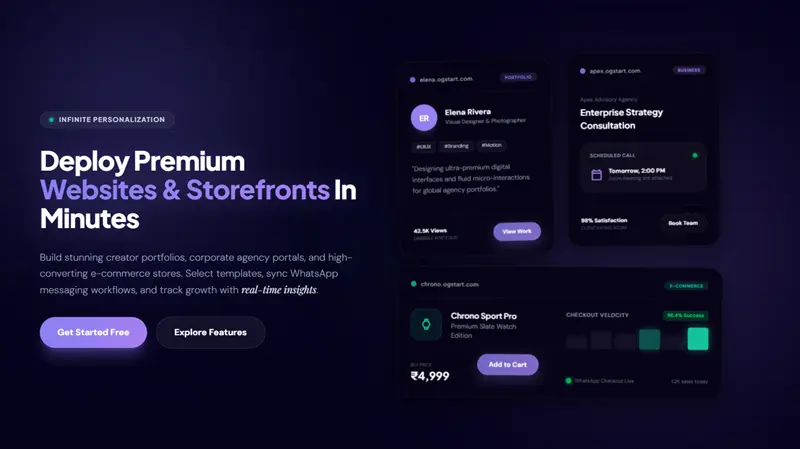
Crafting a compelling senior UX portfolio doesn't require a hefty investment in complex website builders or expensive hosting. This is where OGStart.com becomes your strategic partner, enabling you to launch a professional, high-impact online presence without the prohibitive upfront costs.
Why OGStart is Your Ideal Launchpad
OGStart is built for ambitious individuals like you – freelancers, creators, and professionals aiming to elevate their online presence affordably. We strip away the complexity and high costs typically associated with custom website development or premium platforms. Our core brand message resonates with the journey of a senior UX designer: Start small, launch fast, and upgrade only when growth demands it. We empower you to validate your professional narrative and showcase your expertise with minimal financial risk.
Our platform handles the hosting, infrastructure, and website management, allowing you to focus purely on curating and presenting your design work. You can create an impressive portfolio website for just INR 99, a fraction of the cost you might expect elsewhere. This low entry barrier means you can invest your valuable time and resources into refining your case studies and preparing for interviews, rather than wrestling with technical complexities or budget constraints.
Step-by-Step: Creating Your Professional Portfolio Website for Just Rs. 99
We've made the process incredibly straightforward to ensure you can launch your senior-level portfolio quickly and efficiently:
- Choose Your Template: OGStart offers a range of professional, clean templates perfectly suited for portfolios. Select one that aligns with your personal brand and desired aesthetic.
- Upload Your Content: Seamlessly integrate your meticulously crafted case studies, "About Me" section, and contact information. Our intuitive interface allows you to add images, videos, and detailed descriptions with ease.
- Connect Your Domain (Optional, but Recommended): While you can start with an OGStart subdomain, we strongly recommend connecting your own custom domain (e.g., yourname.com) for maximum professionalism and brand recall. Remember, you'll need to acquire your domain separately, but OGStart handles the technical setup for connecting it to your new portfolio site.
- Launch for Rs. 99: Publish your professional online portfolio. For just INR 99, you gain a fully hosted, managed website that positions you as a serious contender for senior roles.
This affordable and rapid deployment ensures that your portfolio is live and ready for recruiters and hiring managers to review without delay.
Scaling Your Online Presence as You Grow
The beauty of OGStart lies in its scalability. As you land that high-paying senior role, you might find the need for more advanced features, custom integrations, or expanded storage. OGStart allows you to upgrade your plan seamlessly, only paying for what you need when your business—or your career—demands it. This aligns perfectly with our philosophy: don't pay like a big brand on day one; upgrade only when growth demands it.
Advanced Strategies for Senior UX Portfolio Success
Beyond the core components, certain advanced strategies can further distinguish your portfolio in the eyes of senior hiring managers.
Tailoring Your Portfolio to Specific Roles
While a general portfolio is a starting point, we advise tailoring your selections for each application. Carefully read the job description for the senior role you're applying for and highlight projects that specifically demonstrate the required skills and experiences. If a role emphasizes user research, lead with a case study showcasing your deep research capabilities. If it's about product strategy, emphasize projects where you influenced the product roadmap.
Leveraging Personal Projects and Thought Leadership
Even if you have substantial professional experience, personal projects can demonstrate initiative, continuous learning, and an exploration of new tools or methodologies. Furthermore, thought leadership—through blogging, speaking at conferences, or mentoring—can significantly bolster your authority. If you've contributed to design communities or shared insights, include these as they showcase leadership and industry involvement.
Networking and Presenting Your Work
Your portfolio is a conversation starter, not the entire conversation. Actively network, seek feedback on your portfolio, and be prepared to articulate your case studies verbally. Practice presenting your work, focusing on the problem, your process, and the business impact, just as you would in an interview setting. This demonstrates strong communication skills, a hallmark of a senior professional.
| Portfolio Characteristic | Junior/Mid-Level Portfolio | Senior-Level Portfolio |
|---|---|---|
| Primary Focus | Showcasing execution skills, visual design, and tools proficiency. | Demonstrating strategic thinking, business impact, leadership, and problem-solving. |
| Case Studies | "What I Did" – detailing tasks, deliverables. | "Why I Did It & What Happened" – focusing on problem, process, solution, and measurable business outcomes. |
| Content Quantity | Often many projects, showcasing breadth of experience. | Curated selection (3-5) of high-impact projects, showcasing depth. |
| Role Emphasis | Individual contribution to a team. | Leadership, mentorship, stakeholder management, cross-functional collaboration. |
| Metrics | May be absent or focus on UX metrics (e.g., usability scores). | Explicitly links UX work to business metrics (e.g., conversion, retention, ROI). |
| Narrative | Chronological presentation of work. | Storytelling of challenges, decisions, and impact, reflecting growth and learning. |
We strongly advocate for understanding your audience. The hiring manager is looking to de-risk their hire; your portfolio should make their decision easy by clearly articulating your value. For example, a B2B company might value practical solutions and measurable efficiency gains more than intricate visual details.
Conclusion
Bypassing the junior trap and landing high-paying senior UX design roles requires a fundamental shift in how you present your professional story. Your portfolio must transcend a simple collection of projects to become a powerful testament to your strategic thinking, leadership capabilities, and quantifiable business impact. We've seen how effectively highlighting your problem-solving process, demonstrating cross-functional collaboration, and showcasing the tangible results of your design work can set you apart.
Remember, senior roles aren't just about design execution; they are about orchestrating impactful solutions that drive organizational success. By focusing on the "why" and "what happened" in your case studies, and by clearly articulating your leadership and influence, you position yourself as the invaluable strategic partner that top companies are seeking. We encourage you to leverage platforms like OGStart.com to build and host your world-class portfolio affordably, empowering you to put your best foot forward without financial strain. Launch your impactful senior UX portfolio today for just INR 99, and take the definitive step towards securing your next high-paying role. Your career growth deserves a platform that scales with your ambition.