
New Shopify Store SEO: 6 'Quick Win' Strategies to Outrank Rivals & Drive Sales (No Waiting Game Req
Launching a new Shopify store is an exhilarating journey, filled with product curation, branding excitement, and the dream of reaching customers worldwide. However, the sheer volume of online businesses can make standing out feel like an uphill battle. Many new entrepreneurs assume SEO is a long-term game, a "waiting game" that only established brands can afford to play. We are here to tell you that this couldn't be further from the truth. With the right strategies, your new Shopify store can achieve significant search engine optimization (SEO) "quick wins," driving traffic and sales without the high upfront costs or the tedious wait.
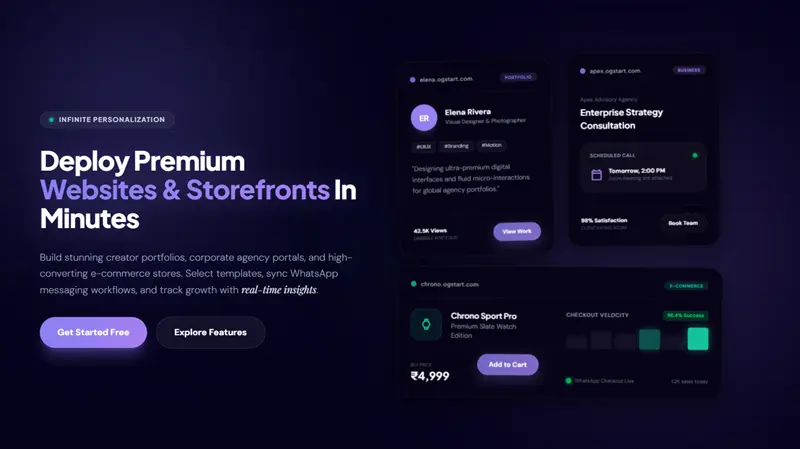
At OGStart.com, we understand the challenges of starting small. We believe that launching your business online should be affordable and empower you to validate your ideas quickly, without the pressure of paying like a big brand from day one. Our platform allows you to create an online store, portfolio, or business website for as little as INR 99, with the flexibility to upgrade only when your business truly grows. This philosophy extends directly to your SEO efforts: focus on impactful, low-cost strategies that deliver tangible results early on. We systematically analyzed successful new e-commerce ventures and distilled six actionable "quick win" SEO strategies that can help your Shopify store outrank rivals and kickstart sales from the very beginning.
Why Early SEO Wins Are Crucial for Your New Shopify Store
In the vast digital marketplace, visibility is paramount. If potential customers can't find your products, they can't buy them. While paid advertising offers instant exposure, it often comes with a hefty price tag, making it unsustainable for many new businesses. Organic search, on the other hand, provides a consistent, cost-effective stream of highly motivated traffic. Studies show that a significant portion of e-commerce traffic, up to 43%, originates from organic Google search, making it the single largest traffic source for online retail. Moreover, SEO can drive over 1,000% more traffic than organic social media alone, highlighting its power.
The "waiting game" mentality suggests that SEO takes months or even years to show results. While comprehensive SEO certainly has long-term components, neglecting it from day one means missing out on immediate opportunities. By implementing targeted "quick win" strategies, you can begin attracting relevant visitors, validating your product market fit, and generating initial sales much faster. This early momentum is vital for growth, allowing you to reinvest in your business and scale your marketing efforts strategically. For businesses launched on platforms like OGStart, where affordability and rapid validation are key, maximizing early SEO potential is not just an advantage—it's a necessity.
Understanding E-E-A-T for Shopify Success
Before diving into specific tactics, it's essential to grasp a fundamental concept that guides Google's search algorithms: E-E-A-T. This acronym stands for Experience, Expertise, Authoritativeness, and Trustworthiness. It's a framework Google's human quality raters use to assess the overall quality of web content, ensuring users receive accurate, reliable, and genuinely helpful information. While not a direct ranking factor, strong E-E-A-T signals help align your site with Google's definition of quality, improving your chances of ranking higher.
For an e-commerce store, E-E-A-T means demonstrating that you (or your brand) have genuine experience with the products you sell, possess expertise in your niche, are recognized as an authority, and are trustworthy. This is especially critical for "Your Money or Your Life" (YMYL) topics, which include purchasing decisions where bad advice could have significant negative impacts. Even as a new Shopify store, you can build E-E-A-T by showcasing product knowledge, providing excellent customer service, gathering authentic reviews, and presenting clear, factual information. Your goal is to convince both search engines and potential customers that you are a credible source in your product category.
6 Quick Win SEO Strategies for Your New Shopify Store
We've identified these six strategies as "quick wins" because they generally require less technical expertise, can be implemented relatively quickly, and often yield noticeable results faster than more complex SEO endeavors. They are perfect for new Shopify store owners looking to make an immediate impact.
1. Master Your Product Page SEO: The Low-Hanging Fruit
Your product pages are the heart of your e-commerce business. They are where conversions happen, and optimizing them effectively is arguably the fastest way to see SEO results. We focus intensely on these pages because they directly address user intent: someone searching for a specific product is often ready to buy.
Keyword Research Basics for Products: Don't just guess what people are searching for. Use keyword research tools (even free ones like Google Keyword Planner) to identify long-tail keywords—more specific, multi-word phrases—that describe your products. For example, instead of just "running shoes," consider "men's lightweight trail running shoes size 10" or "waterproof women's hiking boots." Long-tail keywords often have lower competition and higher conversion rates.
Optimizing Titles, Descriptions, and Alt Text: Each product page needs a unique, keyword-rich title tag (the HTML <title> tag) and a compelling meta description. These appear in search results and directly influence click-through rates. Your product descriptions should be detailed, informative, and persuade customers while naturally incorporating keywords. Don't use generic manufacturer descriptions; write unique content that highlights your product's benefits and features. Additionally, optimize your image alt text with descriptive keywords. This not only helps search engines understand your images but also improves accessibility for users with visual impairments.
Importance of Unique, Detailed Product Descriptions: Beyond keywords, unique product descriptions build E-E-A-T. They showcase your experience and expertise with the product. Provide specifications, usage tips, maintenance instructions, and even stories behind the product if applicable. The more detailed and helpful your content, the more valuable Google and your customers will find it.
2. Implement Strategic Internal Linking for Authority Flow
Internal links are hyperlinks that point to other pages within the same domain. They are crucial for both user experience and SEO. Search engines use internal links to discover new pages, understand the structure of your website, and gauge the relative importance of different pages. A strong internal linking structure helps distribute "link equity" (authority) throughout your site, boosting the ranking potential of your key product and category pages.
How Internal Links Help: When a high-authority page on your site links to a less authoritative but important page, it passes some of its "power" to the linked page. This helps search engines understand topical relationships and can improve the linked page's visibility. For users, clear internal links guide them through your product catalog, blog content, and informational resources, enhancing their shopping experience.
Best Practices: Link from relevant blog posts to your product pages, from category pages to individual products, and between related products. Use descriptive, keyword-rich anchor text for your internal links. Instead of "click here," use "discover our handmade leather wallets" when linking to a wallet product page. Shopify's SEO lead, Kyle Risley, suggests linking to all collections in your main navigation to signal their importance to search engines.
3. Leverage Google My Business (GMB) for Local Visibility (Even for Online Stores!)
Even if your Shopify store is purely online, optimizing for local search can be a significant quick win, especially if you target customers in specific geographic regions or have a physical presence (like a home office or fulfillment center that customers might search for). Many online shoppers start their journey with local searches, even for products they intend to buy online.
Importance of GMB: A well-optimized Google Business Profile (formerly Google My Business) helps your store appear in local search results and on Google Maps. This is invaluable for driving brand awareness and trust. People often search for business addresses, hours, and reviews before making a purchase.
Setting Up and Optimizing Your Profile: Claim and verify your Google Business Profile. Fill out every section completely and accurately: business name, address (even if it's a service area, specify it), phone number, website URL, business hours, and categories. Upload high-quality photos. Encourage customers to leave reviews, and respond to them promptly and professionally. Positive reviews significantly impact conversion rates and build trust.
4. Optimize for Mobile-First Indexing & Page Speed
In today's mobile-first world, your store's performance on smartphones is non-negotiable. Google primarily uses the mobile version of your website for indexing and ranking. A slow or clunky mobile experience will not only frustrate customers but also negatively impact your search rankings.
Why Mobile is Critical: Mobile commerce constitutes a massive 68% of all e-commerce traffic, and 63% of Google searches occur on mobile devices. If your site isn't fast and user-friendly on mobile, you're losing a huge portion of your potential audience.
Page Speed Tips: While platforms like Shopify (and OGStart, which handles hosting and infrastructure) take care of many technical aspects, there are still actions you can take. Compress your product images before uploading them to reduce file size without sacrificing quality. Choose a clean, responsive Shopify theme known for its speed. Regularly check your site's speed using tools like Google PageSpeed Insights. A one-second delay in page load time can reduce conversions by 7%.
5. Create High-Value, Keyword-Rich Blog Content (Even Small Posts!)
Content marketing is a powerful long-term SEO strategy, but it can also deliver quick wins. Even short, focused blog posts can attract targeted traffic and establish your store as an expert in its niche.
Content Ideas: Think about your customers' questions and pain points. What information would help them make a purchase decision or get the most out of your products? Examples include "5 Ways to Style a Silk Scarf," "Guide to Choosing the Right Coffee Beans," or "How to Care for Your Handmade Jewelry."
Solving Customer Problems: Blog content that answers common questions or solves problems directly relates to E-E-A-T. It demonstrates your expertise and builds trust. Each post should target a specific keyword or topic and provide genuine value. Link these blog posts back to relevant product pages, driving both SEO value and potential sales.
Short, Focused Articles: You don't need to write 2,000-word epics to start. Short, well-researched articles (500-800 words) that directly address a specific search query can quickly rank and drive traffic. Consistently publishing helpful content signals to Google that your site is active and a valuable resource.
6. Embrace Structured Data (Schema Markup) for Rich Snippets
Structured data, also known as schema markup or rich snippets, is code you add to your website's HTML to give search engines explicit information about your page's content. This helps search engines understand your content more deeply and can lead to enhanced search results listings, which are much more eye-catching.
What Structured Data Does: While structured data isn't a direct ranking factor, it can significantly improve your click-through rate (CTR) by making your search listings stand out. For e-commerce, this often means displaying product ratings, pricing, availability, and review counts directly in the search results.
Common E-commerce Schema Types: The most important schema types for Shopify stores are "Product" schema, "Review" schema, and "Offer" schema. Product schema provides details like name, price, availability, and images. Review schema allows star ratings to appear, increasing trust and visibility. Many Shopify themes include basic schema markup, but it's crucial to verify its completeness and accuracy. Tools like Google's Rich Results Test can help you validate your structured data. We recommend using JSON-LD format, as it is Google's preferred method for implementation.
Comparing Shopify SEO Approaches: Quick Wins vs. Long-Term Strategies
While the quick wins discussed above can provide immediate momentum, it's important to understand how they fit into a broader, long-term SEO strategy. Both are vital for sustained growth, and often, quick wins lay the foundation for more extensive efforts.
We've prepared a comparison to highlight the differences and synergies between these approaches:
| Feature | Quick Win Strategy | Long-Term Strategy |
|---|---|---|
| Time to Results | Days to weeks | Months to years |
| Cost | Low, often free tools | Potentially higher (tool subscriptions, agency fees) |
| Complexity | Relatively low, actionable steps | High, requires continuous monitoring and adaptation |
| Primary Goal | Immediate visibility, traffic, and initial sales validation | Sustained organic growth, dominant market position, brand authority |
| Keyword Research | Focus on specific, long-tail, high-intent keywords for product pages | Comprehensive analysis, broad and competitive keywords, topic clusters |
| Content Creation | Optimized product descriptions, short problem-solving blog posts | In-depth guides, pillar content, diverse formats (video, infographics), consistent blogging schedule |
| Backlinks | Initial focus on internal linking, local citations (GMB) | Strategic outreach, digital PR, guest posting, broken link building, building industry relationships |
| Technical SEO | Mobile optimization, image compression, basic site speed checks | Advanced crawl budget optimization, server logs analysis, complex structured data implementation, core web vitals optimization |
| Local SEO | Google Business Profile optimization, customer reviews | Hyper-local content, local link building, consistent NAP (Name, Address, Phone) across all directories |
As you can see, quick wins are about immediate impact and efficiency, while long-term strategies build enduring authority and market share. The beauty is that they are not mutually exclusive; quick wins can fund and inform your long-term SEO roadmap.
Your Journey Starts Now: Building an Empire with OGStart
The digital landscape is competitive, but it's also brimming with opportunities for new entrepreneurs. The idea that you must spend a fortune or wait indefinitely for your online store to gain traction is a myth we at OGStart are determined to debunk. By focusing on these six "quick win" SEO strategies, you're not just optimizing your Shopify store; you're actively building a foundation for sustainable growth.
We've seen countless founders hesitant to dive into e-commerce due to perceived complexities and costs. This is precisely why OGStart exists: to remove those barriers. Imagine launching your complete online store for INR 99, with hosting and infrastructure handled, and then immediately applying these quick-win SEO tactics. You gain instant visibility, attract your first customers, and generate sales, all while keeping your initial investment minimal. This approach allows you to validate your business idea affordably and quickly, without the pressure of a "waiting game."
As your business flourishes and demand grows, OGStart ensures you can scale seamlessly. You only upgrade your plan when your business genuinely grows, not before. This aligns perfectly with an SEO strategy that starts lean, focuses on efficiency, and builds momentum over time. Stop waiting for the perfect moment or the big budget. The time to implement powerful SEO that drives sales is now.
Launch your business online for INR 99. Upgrade only when your business grows. That's the OGStart promise, empowering you to start small, launch fast, and make your mark.
We urge you to take these strategies and apply them. Monitor your progress, learn from your results, and iterate. The most successful businesses are those that are agile and responsive. Your new Shopify store deserves every chance to succeed, and with these quick wins and the supportive framework of OGStart, you're well on your way to outranking rivals and building the e-commerce empire you envision.