
The 2026 Accessibility Advantage: Your 7-Point Compliance Checklist for Small Service Businesses to
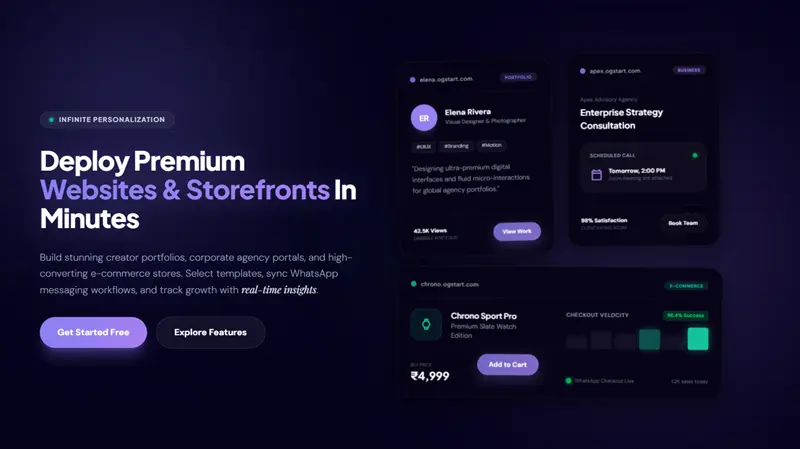
The digital world moves fast. For small service businesses, staying competitive means not just keeping up, but getting ahead. In 2026, one of the most powerful yet often overlooked advantages is web accessibility. It’s no longer just about doing the right thing; it's a strategic imperative that can significantly grow your client base and safeguard your business from costly legal challenges. At OGStart.com, we believe that launching and growing your online business should be affordable and secure. That's why we've systematically analyzed the landscape to bring you this essential 7-point compliance checklist, designed specifically for first-time founders, freelancers, and local businesses like yours.
Imagine being able to reach a market segment of over one billion people globally, including 1-in-4 adults in the United States, who live with some form of disability. These are potential clients who are often underserved by inaccessible websites. By embracing accessibility, you're not just opening your doors wider; you're actively inviting them in. Furthermore, the legal climate is intensifying, with website accessibility lawsuits increasing year over year, targeting businesses of all sizes, not just large corporations. We understand that as a small business owner, every rupee, dollar, or euro counts, and unexpected lawsuits can be devastating. This article will equip you with the knowledge and actionable steps to navigate the 2026 accessibility landscape, ensuring your online presence is not only compliant but also a powerful engine for growth. Let's make your website a magnet for new clients and a fortress against legal risks.
Why Accessibility Isn't Just Good Ethics – It's Good Business
For too long, web accessibility has been viewed as an optional add-on, a noble gesture perhaps, but not a core business strategy. We contend that this perspective is not only outdated but actively detrimental to a small business's potential for growth and stability. In 2026, accessibility is unequivocally a cornerstone of smart business operations.
Expanding Your Client Base: The Untapped Market
Consider the sheer size of the market you might be missing. Over one billion people worldwide live with a disability, representing a significant portion of the global population with considerable spending power. In the United States alone, approximately 1-in-4 adults live with a disability. If your website isn't accessible, you are effectively putting up a "closed" sign to these potential clients, pushing them towards competitors who have embraced inclusivity. By making your website usable by everyone, you instantly unlock a new, eager audience, directly impacting your sales and market share. Beyond those with permanent disabilities, accessible design also benefits individuals with temporary impairments (like a broken arm), situational challenges (such as bright sunlight or a noisy environment), and the growing population of older adults who may experience changing abilities due to aging. This expanded reach translates directly into increased client acquisition and enhanced customer loyalty.
Shielding Your Business: Avoiding Costly Lawsuits
The legal landscape surrounding web accessibility is not only evolving but intensifying. Website accessibility litigation has shown consistent growth every year since 2017 and shows no signs of slowing down. In 2025 alone, over 5,000 digital accessibility lawsuits were filed in federal and state courts across the United States. Crucially, these lawsuits are not exclusively targeting large corporations; a significant majority of targets are small and mid-sized companies with annual revenues under USD 25 million.
We've observed that many of these cases begin not with a court summons, but with a demand letter from a plaintiff's attorney, typically requesting a settlement between USD 10,000 and USD 25,000 before filing a formal lawsuit. Should a case proceed, legal defense fees can range from USD 30,000 to USD 175,000, in addition to the required remediation work. Furthermore, nearly half of federal ADA cases in 2025 involved companies that had been sued previously, highlighting that merely settling a demand letter without fixing the underlying issues provides no long-term protection. Proactive compliance with established guidelines, such as WCAG 2.2, is your most effective defense against such financial and reputational risks.
Boosting Your Brand Image and SEO
In today’s socially conscious marketplace, consumers increasingly support businesses that demonstrate inclusivity and social responsibility. An accessible website signals to your audience that you care about every potential client, fostering trust and strengthening your brand reputation. This positive brand perception can be a significant differentiator in a crowded market.
Beyond ethics, accessibility also offers tangible SEO benefits. Many accessibility best practices naturally align with good SEO strategies. For instance, well-structured headings, descriptive alt text for images, and keyboard-navigable interfaces make your site easier for search engine crawlers to understand and index, potentially improving your search rankings. A more usable site also leads to better user engagement, lower bounce rates, and longer dwell times – all signals that search engines favor.
The 2026 Landscape: What Small Businesses Need to Know Now
The year 2026 marks a critical juncture for web accessibility. Understanding the evolving regulatory environment and the prevailing standards is paramount for small service businesses seeking to thrive online.
Key Regulatory Shifts and Deadlines
While a comprehensive federal web accessibility law for private entities in the U.S. doesn't explicitly state WCAG compliance, the Americans with Disabilities Act (ADA) has been interpreted by the U.S. Department of Justice to include websites as "places of public accommodation," making them subject to ADA Title III. This means businesses are legally required to make their websites accessible to people with disabilities. Courts increasingly reference the Web Content Accessibility Guidelines (WCAG) when evaluating compliance under the ADA.
Notably, in April 2024, the Department of Justice issued a final rule establishing WCAG 2.1 Level AA as the explicit standard for state and local government entities under ADA Title II, with some compliance deadlines extending to April 2026 and beyond. While this rule directly applies to government bodies, it reinforces WCAG 2.1 Level AA (and by extension, WCAG 2.2 Level AA) as the de facto legal benchmark for digital accessibility across the board. For private businesses, this means the pressure to conform to these standards, particularly WCAG 2.2, is higher than ever.
Understanding WCAG: Your Guiding Principles
The Web Content Accessibility Guidelines (WCAG) are the global standard for making web content accessible to individuals with disabilities, developed by the World Wide Web Consortium (W3C). WCAG 2.2, published on October 5, 2023, and subsequently adopted as ISO/IEC 40500:2025, is the current W3C Recommendation and the benchmark for accessibility compliance and best practices.
WCAG 2.2 is built upon four core principles, often remembered by the acronym POUR:
- Perceivable: Information and user interface components must be presentable to users in ways they can perceive. This means providing text alternatives for non-text content, captions for audio, and sufficient contrast.
- Operable: User interface components and navigation must be operable. This includes ensuring all functionality is available via keyboard, providing enough time for users to interact, and avoiding content that causes seizures.
- Understandable: Information and the operation of the user interface must be understandable. This means making text readable and understandable, making web pages appear and operate in predictable ways, and helping users avoid and correct mistakes.
- Robust: Content must be robust enough that it can be interpreted reliably by a wide range of user agents, including assistive technologies.
Most businesses should aim for WCAG 2.2 Level AA compliance, as this is the standard most commonly referenced in legal actions and considered the universally expected conformance target for legal and best practices. While WCAG 2.2 builds on previous versions (2.0 and 2.1), it introduces nine new success criteria primarily focused on improving accessibility for users with cognitive disabilities, low vision, and limited mobility. Many websites that met WCAG 2.1 may still fail WCAG 2.2, underscoring the need for updated compliance strategies.
Your 7-Point Accessibility Compliance Checklist for Small Service Businesses
Achieving WCAG 2.2 Level AA compliance might seem daunting, but we've broken it down into actionable steps. Focus on these key areas to significantly enhance your website's accessibility, attract more clients, and protect your business.
H3: Point 1: Accessible Website Design and Development
The foundation of an accessible website lies in its core design and underlying code. This includes ensuring your site's structure is logical, uses semantic HTML, and responds well across different devices and screen sizes. For OGStart users, our platform provides a robust and modern foundation, but the content you add and how you customize your theme also play a crucial role. We recommend using heading tags (<h1>, <h2>, etc.) correctly to outline your content hierarchy, as screen readers rely on these for navigation. Ensure your website content works in both portrait and landscape orientations, especially for mobile users.
H3: Point 2: Clear and Concise Content
The readability and comprehensibility of your content are vital. Use simple, direct language that avoids jargon where possible. Break up long paragraphs into shorter, digestible chunks. Employ bullet points and numbered lists to present information clearly. Ensure navigation elements are consistent across your site, making it predictable for users to find help or other sections. This benefits everyone, especially those with cognitive disabilities or learning differences. Clearly label all interactive elements and provide straightforward instructions for user input.
H3: Point 3: Image Alt Text and Media Captions
Every informative image on your website must have descriptive "alt text" (alternative text). This text is read aloud by screen readers, allowing visually impaired users to understand the content and purpose of the image. Avoid keyword stuffing or generic descriptions. For videos, provide accurate closed captions for spoken dialogue and important sounds, benefiting individuals who are deaf or hard of hearing, as well as those in sound-sensitive environments. Transcripts for audio-only content are also highly recommended. This is one of the most common WCAG failures, leading to legal exposure.
H3: Point 4: Keyboard Navigation Functionality
All interactive elements and content on your website must be fully operable using only a keyboard, without requiring a mouse. This is essential for users with motor impairments or those who rely on screen readers. Test your website by tabbing through all links, buttons, and form fields. Ensure that a clear visual focus indicator (a visible outline or highlight) appears around the element currently in focus, and that this indicator is not obscured by other content. This is a new emphasis in WCAG 2.2.
H3: Point 5: Color Contrast and Readability
Sufficient color contrast between text and its background is critical for users with low vision or color blindness. WCAG 2.2 requires a minimum contrast ratio of 4.5:1 for normal text and 3:1 for large text, as well as for user interface components like buttons and focus indicators. Use online contrast checkers to verify your color choices. Also, avoid using color as the sole means of conveying information. For example, don't rely only on red text to indicate an error; also include an icon or descriptive text.
H3: Point 6: Accessible Forms and Interactive Elements
Online forms are a common point of frustration for users with disabilities. Ensure all form fields have clearly associated labels (using the <label> tag in HTML). Provide clear instructions and helpful error messages that are easily perceivable. Interactive elements like buttons, checkboxes, and radio buttons must be clearly identified and navigable by keyboard. WCAG 2.2 also introduces criteria for "Accessible Authentication" (allowing alternatives to complex CAPTCHAs or memory-intensive passwords) and "Redundant Entry" (avoiding asking users to re-enter information already provided in the same session). This is particularly helpful for users with cognitive disabilities.
H3: Point 7: Regular Accessibility Audits and User Testing
Accessibility is not a one-time fix but an ongoing commitment. Regularly conduct basic accessibility audits using free automated tools like WAVE or Google Lighthouse. While automated tools can catch many issues, they don't catch everything. We strongly recommend manual testing, especially with a keyboard, and, ideally, involving individuals with disabilities to test your site. This "real-world" user testing provides invaluable insights into actual usability barriers. Remember, installing an accessibility overlay widget alone does not guarantee legal protection; courts have ruled against businesses relying solely on these, as the underlying code issues remain.
Accessibility Made Easy: How OGStart Supports Your Journey
At OGStart.com, our mission is to empower you to launch your business online affordably and with confidence. We understand that as a first-time founder or small business owner, resources are often limited. That's why our platform is designed to give you a head start on accessibility, allowing you to focus on your clients and growth without getting bogged down by complex technical details.
Launching Your Accessible Foundation with OGStart
When you create an online store, portfolio, or business website with OGStart for just Rs. 99, you're not just getting a basic online presence. You're building on a modern, robust infrastructure that inherently supports many accessibility principles. Our platform is built with clean, semantic HTML, which is a crucial first step toward making your site understandable by assistive technologies. We handle the hosting and platform infrastructure, ensuring your site is responsive and performs well across various devices, which is fundamental to operability and perceivability for all users, including those with disabilities.
While you bring your own domain, the underlying system OGStart provides simplifies the technical heavy lifting. This allows you to concentrate on creating accessible content – writing clear product descriptions, adding descriptive alt text to your images, and ensuring your forms are user-friendly – knowing that the core framework is already designed for modern web standards. We encourage the use of clear, well-structured content, which naturally aligns with WCAG guidelines for understandability.
Scaling Your Accessible Business Affordably
Our core brand message is simple: "Launch your business online for Rs. 99. Upgrade only when your business grows." This philosophy extends to accessibility. We don't want accessibility to be a barrier, but an enabler. As your business expands, the foundational accessibility elements provided by OGStart mean you won't need to rebuild your entire site from scratch to meet evolving standards. You can incrementally improve your content and design choices, scaling your accessibility efforts as your business scales. This low-risk starting point allows you to validate your business ideas affordably while still building an inclusive and compliant online presence from day one. You don't pay like a big brand on day one, but you can certainly build a website that meets big-brand accessibility standards over time, supported by our platform.
Accessibility Benefits: Short-Term Gains vs. Long-Term Security
Understanding the immediate and lasting impacts of web accessibility can help prioritize your efforts. Here's a comparison of the key benefits:
| Benefit Category | Short-Term Gains (Immediate Impact) | Long-Term Security (Sustainable Advantage) |
|---|---|---|
| Client Acquisition & Market Reach | Access to a larger immediate pool of users, including individuals with disabilities and older adults. Improved user experience for all, leading to quicker conversions. | Significantly expanded and loyal customer base. Enhanced reputation as an inclusive brand, attracting diverse clientele for years to come. |
| Legal & Compliance | Reduced risk of immediate demand letters and initial lawsuits. Demonstrates good-faith effort towards compliance. | Bulletproof legal protection against ongoing litigation. Avoidance of costly settlements and legal fees. Peace of mind for sustainable business operations. |
| Brand & Reputation | Instant positive perception for being inclusive and ethical. Strengthened trust with early adopters. | Deep-seated brand loyalty and strong positive public image. Differentiation from competitors who neglect accessibility. Enhanced credibility. |
| SEO & Visibility | Improved search engine crawling and indexing. Potential for higher rankings for relevant queries due to better technical SEO. | Sustained organic traffic growth. Competitive advantage in search results as accessibility becomes an increasingly weighted ranking factor. |
| Cost & Efficiency | Avoiding immediate costs associated with reactive lawsuit settlements and emergency remediation. | Reduced long-term maintenance costs by embedding accessibility from the start. Avoiding expensive redesigns. Efficient content management. |
Conclusion: Embrace the 2026 Accessibility Advantage
The 2026 accessibility landscape presents both challenges and unparalleled opportunities for small service businesses. It's a call to action to move beyond mere compliance and embrace a strategic advantage that will differentiate your brand, grow your client base, and secure your future. We've seen how integrating web accessibility isn't just about meeting legal requirements; it's about unlocking significant market potential and building a resilient, ethical business.
By following this 7-point checklist, you are taking concrete steps towards a more inclusive, robust, and profitable online presence. Remember, the journey towards full accessibility is ongoing, but the initial steps are critical. As the World Wide Web Consortium (W3C) itself states, WCAG 2.2 is the benchmark for making web content accessible to people with disabilities, and failing to meet Level AA exposes organizations to legal and regulatory risks according to the W3C Web Accessibility Initiative. The U.S. Department of Justice has also clarified that websites are public accommodations under the ADA, reinforcing the legal obligation for accessibility as detailed in ADA.gov resources.
At OGStart.com, we are committed to providing you with the foundation to build an accessible online business quickly and affordably. Launch your ecommerce store, portfolio, or business website for just Rs. 99, knowing that our platform handles the complexities of hosting and infrastructure. This empowers you to focus on creating accessible content and growing your clientele, upgrading only when your business truly demands it. Don't wait for a lawsuit to make accessibility a priority. Seize the 2026 Accessibility Advantage today and position your small service business for unprecedented success and security.