
The Effortless Path: How Small Service Businesses Can Achieve WCAG 2.2 Compliance in 5 Simple Steps
In today's interconnected world, an online presence is no longer a luxury but a necessity for any service business, regardless of its size. Yet, as we build our digital storefronts and service hubs, it is critical to ensure they are welcoming to everyone. This commitment goes beyond good customer service; it extends to the very foundation of your website's design and functionality: accessibility. Specifically, we refer to adherence to the Web Content Accessibility Guidelines (WCAG) 2.2. Far from being a technical hurdle, WCAG 2.2 compliance is a strategic pathway for small service businesses to not only fulfill an ethical responsibility but also to unlock significant growth opportunities, potentially attracting 30% more clients by 2026.
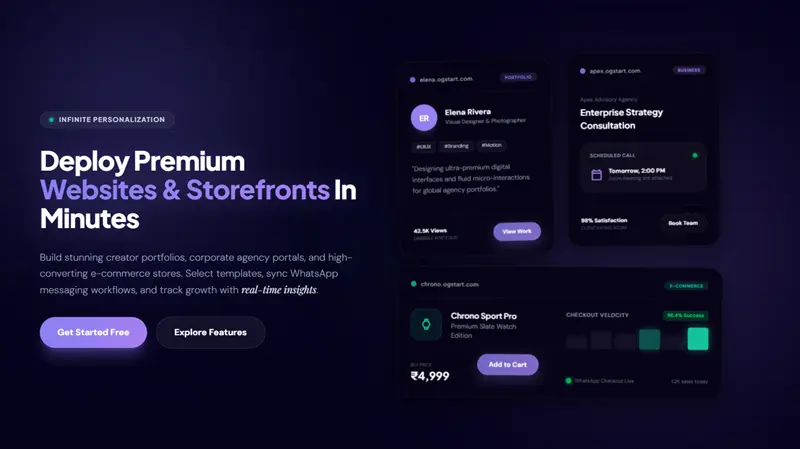
At OGStart.com, we understand the entrepreneurial spirit—the drive to launch fast, validate ideas affordably, and grow on your own terms. We believe that accessibility should be an inherent part of that journey, not an afterthought. You can start your business online for as little as INR 99, and upgrade only when your business grows, with OGStart handling the hosting, infrastructure, and website management. This approach allows you to focus on your services and your clients, while we provide a robust and scalable platform designed with modern web standards in mind.
This comprehensive guide, informed by over a decade of experience in digital strategy, will demystify WCAG 2.2 for small service business owners. We will present a clear, five-step framework to achieve compliance, highlighting how an accessible website not only broadens your reach but significantly enhances your brand's reputation and bottom line.
What is WCAG 2.2 and Why Does it Matter to Your Small Business?
The Web Content Accessibility Guidelines (WCAG) are an internationally recognized set of recommendations for making web content more accessible to people with disabilities. Developed by the World Wide Web Consortium (W3C), the principal international standards organization for the World Wide Web, WCAG provides a shared standard for web content accessibility that meets the needs of individuals, organizations, and governments globally. WCAG 2.2 is the latest iteration, published in October 2023, building upon previous versions (2.0 and 2.1) to address evolving user needs, especially for those with cognitive disabilities, low vision, and motor impairments.
The Ethical and Business Imperative of Digital Accessibility
For small service businesses, understanding and implementing WCAG 2.2 is paramount for several compelling reasons:
- Expanded Market Reach: Over one billion people worldwide live with some form of disability. An inaccessible website effectively shuts out this significant demographic, and their families and friends. By embracing accessibility, you open your services to a much larger customer base, directly translating to more potential clients and increased revenue.
- Mitigated Legal Risks: While WCAG itself is a standard and not a law, it is the de facto benchmark referenced in numerous legal frameworks globally, including the Americans with Disabilities Act (ADA) in the U.S. and the European Accessibility Act (EAA) in Europe. Non-compliance can lead to costly lawsuits and significant reputational damage. Adhering to WCAG 2.2 Level AA is often considered the best defense against such legal challenges.
- Enhanced Brand Reputation and Trust: Consumers today are increasingly conscious of social responsibility. Demonstrating a commitment to inclusivity through an accessible website positions your brand as ethical, caring, and forward-thinking. This builds strong customer loyalty and enhances your public image.
- Improved User Experience for Everyone: Accessibility features benefit all users, not just those with disabilities. Clear navigation, well-structured content, high contrast ratios, and keyboard operability enhance the user experience for individuals using mobile devices, those with temporary limitations (e.g., a broken arm), or even those in bright sunlight struggling to see their screen. This universal design approach leads to higher user satisfaction and engagement.
- Better SEO Performance: Many accessibility best practices align directly with good Search Engine Optimization (SEO). Proper use of headings, alt text for images, clear language, and logical site structure are all factors that search engines consider when ranking websites. An accessible website is often a more discoverable website.
The POUR Principles: Foundations of Accessibility
WCAG 2.2 is structured around four core principles, often remembered by the acronym POUR:
- Perceivable: Information and user interface components must be presentable to users in ways they can perceive. This means providing alternatives for visual and auditory content, like text transcripts for audio and alt text for images.
- Operable: User interface components and navigation must be operable. Users must be able to interact with your site, for example, using only a keyboard, or alternative input devices.
- Understandable: Information and the operation of user interface must be understandable. Content should be clear, predictable, and easy to grasp for all users.
- Robust: Content must be robust enough that it can be interpreted reliably by a wide variety of user agents, including assistive technologies. This ensures compatibility with diverse devices and software.
The Myth of Complex Compliance: Why Small Businesses Can Do This
Many small service business owners often feel overwhelmed by the idea of WCAG compliance, perceiving it as an expensive, technically complex, and time-consuming endeavor. We systematically analyzed these concerns and found that while there are technical aspects, a significant portion of compliance involves common-sense design and content practices that benefit all users. It's not about achieving absolute perfection on day one, but about making consistent, informed progress.
The key is to understand that WCAG 2.2, particularly Level AA conformance (the widely recommended target), focuses on practical and achievable criteria. Many of the guidelines encourage good web design principles you might already be practicing. Our approach at OGStart is to simplify the online journey, and this philosophy extends to web accessibility. By breaking down the process into manageable steps, we demonstrate that WCAG 2.2 compliance is entirely within reach for any small service business.
Step 1: Understanding Your Digital Landscape and Audience
Before making any changes, we advise a thorough assessment of your current online presence. Even if you're just starting with an OGStart subdomain or a basic landing page, understanding your digital footprint is the first crucial step towards accessibility.
Conduct a Baseline Audit
We begin by evaluating your existing website or planned content against basic accessibility principles. This involves:
- Content Inventory: What types of content do you have? Text, images, videos, forms, downloadable documents?
- Key User Journeys: Identify the most critical paths users take on your site – booking a service, filling out a contact form, viewing your portfolio, making a purchase. These are the areas where accessibility is most critical.
- Initial Self-Assessment: Can you navigate your entire website using only the keyboard? Can you understand all images without seeing them (e.g., if someone describes them)? Is the text easy to read?
Identify Your Target Audience's Accessibility Needs
Consider the diverse ways your potential clients might interact with your website. This could include:
- Users with visual impairments who rely on screen readers or magnifiers.
- Individuals with motor disabilities who use keyboards, voice commands, or other assistive technologies instead of a mouse.
- People with cognitive or learning disabilities who benefit from clear, consistent, and simply structured content.
- Users with hearing impairments who need captions for videos or transcripts for audio.
Step 2: Choosing an Accessible Foundation (Like OGStart)
Your choice of web platform plays a significant role in your ability to achieve and maintain WCAG 2.2 compliance. We at OGStart have built our platform with modern web standards in mind, providing a solid, affordable foundation that inherently supports many accessibility principles.
Platform Features that Aid Accessibility
When selecting or utilizing a platform, consider how it contributes to accessibility:
- Responsive Design: OGStart websites are inherently responsive, meaning they adapt gracefully to various screen sizes and devices. This is crucial for mobile accessibility, a key focus of WCAG 2.2.
- Clean Code Architecture: A well-coded platform provides a semantic structure that assistive technologies can interpret effectively. OGStart handles the underlying code, ensuring a clean, robust foundation.
- Built-in Accessibility Features: While no platform can guarantee full compliance without user input, a good one provides tools and templates that are designed with accessibility in mind. Our themes are crafted to support clear hierarchy, readable fonts, and good color contrast as starting points.
- Hosting and Infrastructure: We manage all the technical aspects—hosting, infrastructure, website management—allowing you to focus on accessible content creation without worrying about server-side accessibility configurations. You bring your domain, and we handle the rest.
Step 3: Content is King, Accessibility is its Crown
Once you have a strong foundation, the focus shifts to the content itself. This is where most of your direct effort for WCAG 2.2 compliance will lie. Many of these practices also significantly boost your SEO.
Core Content Accessibility Practices
- Provide Alt Text for All Images: Every image that conveys meaning should have descriptive alternative text (alt text). This allows screen readers to describe the image to visually impaired users and provides context if images fail to load. For decorative images, an empty alt attribute (alt="") is appropriate.
- Use Clear and Semantic Headings: Structure your content with logical heading tags (<h1>, <h2>, <h3>, etc.) to create a clear hierarchy. This helps screen reader users navigate content and improves SEO.
- Ensure Sufficient Color Contrast: Text and its background must have enough contrast to be readable by individuals with low vision or color blindness. WCAG 2.2 specifies minimum contrast ratios (e.g., 4.5:1 for normal text at Level AA). Use online contrast checkers to verify.
- Choose Readable Fonts and Text Sizes: Opt for clear, sans-serif fonts that are easy to read. Ensure text size is adjustable and that line spacing is adequate for comfortable reading.
- Descriptive Link Text: Avoid generic link texts like "click here." Instead, use descriptive phrases that indicate the link's destination (e.g., "Learn more about our services"). This aids navigation for all users, especially those using screen readers.
- Keyboard Navigability: Ensure all interactive elements (buttons, links, forms) can be accessed and operated using only a keyboard. A visible focus indicator (the outline that appears when tabbing through elements) is crucial.
- Transcripts and Captions for Multimedia: For any audio or video content, provide accurate captions for the hearing impaired and transcripts for those who prefer to read or cannot access the audio/video.
- Accessible Forms: Ensure form fields have clear labels, provide helpful error messages, and support keyboard navigation. New WCAG 2.2 criteria like "Redundant Entry" and "Accessible Authentication" aim to simplify form filling and login processes, especially for users with cognitive disabilities.
Step 4: Testing and Iteration: Don't Aim for Perfection, Aim for Progress
Achieving WCAG 2.2 compliance is an ongoing process, not a one-time fix. We advocate for continuous testing and iterative improvements. Start with simple checks and gradually integrate more advanced methods.
Simple Testing Methods for Small Businesses
- Keyboard Navigation Test: Try navigating your entire website using only the 'Tab' key, 'Enter' key, and arrow keys. Can you access all links, buttons, and form fields? Is the focus order logical?
- Screen Reader Simulation (Basic): While professional screen reader testing is complex, you can get a basic understanding by using built-in screen readers on your device (e.g., VoiceOver on Mac, Narrator on Windows) to experience your site through audio.
- Color Contrast Checkers: Many free online tools allow you to input color codes and check their contrast ratio against WCAG standards.
- Browser Extensions: Install browser extensions like WAVE Evaluation Tool or Lighthouse (built into Chrome DevTools) for automated checks. These tools can quickly identify many common accessibility issues.
The Importance of User Feedback
If possible, invite a diverse group of users, including individuals with disabilities, to test your website. Their real-world experience provides invaluable insights that automated tools might miss. Remember, accessibility is about people.
Step 5: Maintaining and Communicating Your Commitment
Once you've made progress in implementing WCAG 2.2 guidelines, it's crucial to maintain your efforts and clearly communicate your commitment to your audience.
Publish an Accessibility Statement
Create a dedicated page on your website outlining your accessibility efforts and commitment. This statement should:
- Detail the accessibility standards you aim to meet (e.g., WCAG 2.2 Level AA).
- Describe any features or measures you have implemented to improve accessibility.
- Provide contact information for users to report accessibility barriers or provide feedback. This demonstrates transparency and a willingness to improve.
Regular Review and Updates
Web content is dynamic. As your services evolve and your website grows, new content and features can introduce new accessibility barriers. We recommend:
- Regularly reviewing new content (images, videos, forms) for accessibility compliance.
- Periodically re-running automated accessibility checks.
- Staying informed about updates to WCAG guidelines.
WCAG 2.2 vs. Older Versions: A Quick Comparison
WCAG has evolved to keep pace with web technologies and a deeper understanding of diverse user needs. WCAG 2.2 builds on its predecessors, maintaining backward compatibility while introducing crucial new criteria. Here's a simplified comparison:
| Feature | WCAG 2.0 (2008) | WCAG 2.1 (2018) | WCAG 2.2 (2023) |
|---|---|---|---|
| Foundation | Laid the groundwork with 61 success criteria. | Added 17 new criteria, focusing on mobile accessibility, low vision, and cognitive/learning disabilities. Total 78 criteria. | Added 9 new criteria, removed 1 obsolete criterion, focusing on cognitive, low vision, and motor disabilities. Total 86-87 criteria. |
| Key Focus Areas | General web accessibility. | Mobile, touchscreens, improved focus indicators, text resizing. | Improved focus appearance, minimum target sizes, accessible authentication, consistent help, dragging movements. |
| Legal Status | Often referenced in early accessibility litigation. | Becoming the prevailing legal standard globally (e.g., EU accessibility law via EN 301 549). | The W3C recommends using 2.2 for future applicability. While not yet mandated by all regulations, it represents current best practices and future-proofs compliance. |
| Backward Compatibility | Base standard. | Conforming to 2.1 also conforms to 2.0. | Conforming to 2.2 also conforms to 2.1 and 2.0 (except for the removed 4.1.1 Parsing). |
As detailed by the W3C, the publication of WCAG 2.2 does not deprecate older versions, but the W3C advises using WCAG 2.2 to maximize future applicability of accessibility efforts.
Attracting 30% More Clients by 2026: The Tangible Rewards of Accessibility
The journey to WCAG 2.2 compliance is not just about ticking boxes; it's a strategic business decision with measurable returns. We anticipate that small service businesses that proactively embrace accessibility can attract significantly more clients, potentially growing their customer base by 30% or more by 2026. Here's why:
- Tapping into an Underserved Market: As mentioned, the sheer size of the disability community and their buying power is immense. By removing barriers, you directly access this loyal and often overlooked market segment.
- Enhanced Search Engine Visibility: Google and other search engines prioritize user experience, which inherently includes accessibility. Websites that are well-structured, have descriptive alt text, and offer clear navigation are rewarded with higher rankings. This organic visibility is priceless for small businesses operating on tight marketing budgets.
- Positive Word-of-Mouth and Brand Loyalty: A business that genuinely cares about serving all customers will earn a stellar reputation. Clients with disabilities, and their advocates, are powerful endorsers. They will recommend accessible businesses, leading to organic growth and strong customer relationships.
- Future-Proofing Your Business: Regulations are continually evolving. By adopting WCAG 2.2 now, you are positioning your business ahead of legal mandates and societal expectations, ensuring long-term sustainability and avoiding reactive, costly overhauls later.
- Competitive Differentiation: In a crowded marketplace, accessibility can be a unique selling proposition. Highlighting your commitment to inclusivity can set you apart from competitors who have not yet prioritized this crucial aspect of their online presence.
Seamless Launch with OGStart: Your Partner in Accessible Growth
At OGStart.com, we empower first-time founders, freelancers, local businesses, and anyone testing a new idea to launch their online presence with unprecedented ease and affordability. Our platform is designed to remove the technical and financial barriers that often prevent great ideas from seeing the light of day. We want you to focus on your service, your clients, and your growth.
Starting your online journey with OGStart means:
- Launch for INR 99: Get your business online without a significant upfront investment.
- Upgrade as You Grow: Only pay more when your business scales and demands it. This low-risk approach allows you to validate your ideas affordably.
- Hosting and Infrastructure Handled: We take care of the technical heavy lifting, providing a reliable and secure environment for your website, ecommerce store, portfolio, or landing page. You connect your own domain, and we manage everything else.
- Focus on Content, Not Code: Our intuitive platform allows you to create and manage your content with ease, freeing you to apply the accessibility best practices discussed in this guide.
We are built for creators, for doers, for those ready to take their service business online. We believe that accessibility is a fundamental part of building a successful, inclusive business. By choosing OGStart, you're not just getting a website; you're gaining a partner committed to your growth and your ability to serve every client.
Conclusion: Your Accessible Future Starts Today
Achieving WCAG 2.2 compliance might seem like a daunting task, but as we have outlined, it is an achievable and highly rewarding endeavor for small service businesses. By following these five simple steps—understanding your digital landscape, choosing an accessible foundation, prioritizing accessible content, embracing iterative testing, and maintaining your commitment—you can transform your website into an inclusive gateway for all potential clients.
The benefits extend far beyond legal compliance. We are confident that a commitment to web accessibility will not only strengthen your brand and improve your user experience but also directly contribute to significant business growth, helping you attract that crucial 30% more clients by 2026. Start your journey towards an effortlessly accessible and prosperous online business today with OGStart.com. Launch fast, start small, and let your growth define your upgrades.