
Inclusive Growth: The Essential 5-Step Accessibility Checklist for Small Service Websites (Protect Y
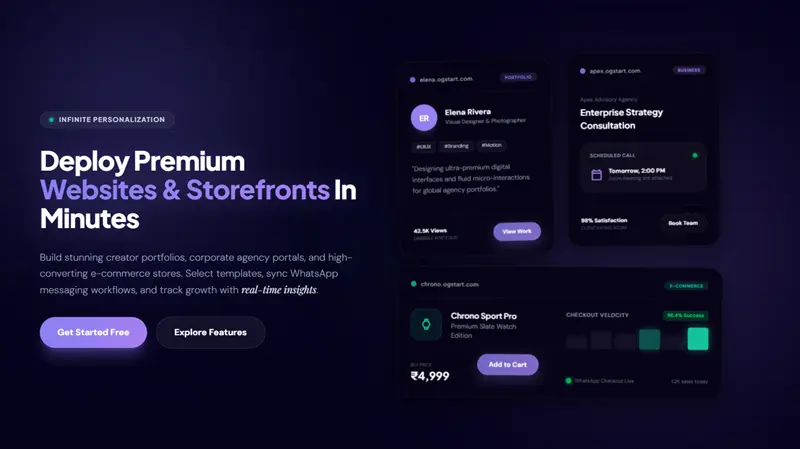
In today's dynamic digital landscape, a website is often the first, and sometimes the only, impression a service business makes. But what if that first impression is inaccessible to a significant portion of your potential clients? At OGStart.com, we systematically analyzed the challenges small businesses face when building an online presence. We understand the drive to launch fast and affordably, testing new ideas without the burden of high upfront costs. However, true growth isn't just about launching; it's about inclusive growth – reaching every potential client. This means prioritizing web accessibility from day one. Protecting your business and reaching more clients hinges on making your digital storefront usable by everyone, regardless of their abilities.
Why Accessibility Isn't Just Good Karma – It's Good Business
When we talk about web accessibility, we are referring to the practice of designing and developing websites so that people with disabilities can perceive, understand, navigate, and interact with the web effectively. This includes individuals with visual, auditory, physical, speech, cognitive, and neurological disabilities. For small service websites, often run by first-time founders, freelancers, or local businesses, the concept of accessibility might seem like an added complexity or an expense that can wait. We're here to tell you it's precisely the opposite.
Embracing accessibility is a fundamental pillar of inclusive growth. It means designing for everyone, which ultimately means serving more people and, in turn, growing your business. It's about breaking down digital barriers, ensuring that your vital information, services, and contact forms are available to all. We have observed that many small businesses inadvertently exclude a considerable market segment by overlooking basic accessibility principles.
The Legal and Ethical Imperatives
Beyond the undeniable ethical responsibility to provide equal access, there are significant legal considerations. In many regions, web accessibility is not merely a recommendation; it's a legal requirement. For instance, in the United States, the Americans with Disabilities Act (ADA) has been widely applied to digital environments, requiring businesses to make their websites accessible to individuals with disabilities. Failing to comply can lead to costly lawsuits and legal penalties, a risk no small business needs to take. As clarified by the U.S. Department of Justice guidance on ADA compliance, inaccessible web content can exclude people just as much as physical barriers.
Moreover, adhering to internationally recognized standards, such as the Web Content Accessibility Guidelines (WCAG) published by the World Wide Web Consortium (W3C), not only helps businesses meet legal requirements but also demonstrates a commitment to inclusivity. These guidelines provide a framework for making web content more accessible and are commonly used as a benchmark for evaluating website accessibility.
The OGStart Advantage: Building an Accessible Foundation from Day One
At OGStart, we empower you to launch your business online for as little as INR 99, with the flexibility to upgrade only when your business grows. This 'start small, launch fast, validate ideas affordably' philosophy extends to accessibility. Our platform is designed to provide a robust, modern foundation, helping you build an online store, portfolio, or business website that is inherently more amenable to accessibility best practices. While you bring your domain, we handle the hosting, infrastructure, and website management, ensuring your site is built on a scalable and accessible framework from the ground up.
Your Essential 5-Step Accessibility Checklist for Small Service Websites
We've distilled the complex world of web accessibility into five actionable steps that small service website owners can implement. These steps are practical, impactful, and designed to help you protect your business while expanding your client reach.
Step 1: Ensure Full Keyboard Navigation and Visible Focus Indicators
Not everyone can use a mouse. Many individuals, including those with motor impairments or visual disabilities, rely solely on a keyboard to navigate websites. They use keys like 'Tab' to move between interactive elements (links, buttons, form fields) and 'Enter' to activate them. We systematically check that every interactive element on your site can be reached and activated using only the keyboard.
- Visible Focus: When a user tabs through your site, there must be a clear visual indicator (a border, a highlight) around the element currently in focus. This is crucial for users to understand where they are on the page.
- Logical Order: The tab order should follow a logical flow that makes sense to a user navigating linearly through the content.
- No Keyboard Traps: Users must be able to tab into and out of all interactive elements, including pop-ups and embedded content, without getting stuck.
Step 2: Provide Clear, Descriptive Content and Alternative Text for Images
Content is king, but accessible content is paramount. We advocate for clear, concise, and understandable language that avoids jargon. For images, we emphasize the use of descriptive alternative text (alt text).
- Meaningful Alt Text: Every image, icon, and graphic that conveys information must have accurate and descriptive alt text. This text is read aloud by screen readers, providing context to users who cannot see the image. For example, instead of "image.jpg," use "A cheerful woman providing virtual consulting services on a laptop."
- Contextual Link Text: Avoid generic link texts like "click here" or "read more." Instead, use descriptive phrases that indicate the link's destination, such as "learn more about our financial planning services." This significantly improves navigation for screen reader users and also boosts your site's SEO.
- Structured Headings: Use proper semantic HTML headings (H1, H2, H3, etc.) to structure your content logically. This not only makes your content easier to scan for all users but also helps screen readers provide a clear outline of the page.
Step 3: Optimize Color Contrast and Visual Clarity
Good visual design isn't just about aesthetics; it's about ensuring readability for everyone, including those with low vision or color blindness. We focus on color contrast and text legibility.
- Sufficient Contrast Ratios: The contrast between text and its background color must meet WCAG guidelines. Tools are available online to check if your color combinations are accessible. Poor color contrast is a common barrier.
- Avoid Color-Only Information: Never rely solely on color to convey information. For example, don't use only red text to indicate an error; also include an icon or descriptive text.
- Clear Typography: Choose legible fonts and ensure text is large enough to read, with adequate line spacing. Users should also be able to resize text without breaking the layout.
Step 4: Leverage Semantic HTML and ARIA Roles for Structure
This might sound technical, but it’s about using the right HTML tags for the right purpose, and OGStart's platform helps facilitate this. Semantic HTML means using tags like <nav> for navigation, <header> for page headers, and <button> for buttons, rather than just generic <div> tags. When building your website with OGStart, our underlying structure helps to lay this foundation correctly.
- Semantic Markup: This provides a clear structure that assistive technologies can interpret. Screen readers rely on this to understand the roles of different page elements.
- ARIA Attributes: (Accessible Rich Internet Applications) roles and attributes can be added to HTML to provide more context to assistive technologies, especially for complex UI components (e.g., carousels, tabs). While this is a more advanced topic, a well-built platform like ours reduces the need for manual intervention for basic elements.
Step 5: Ensure Responsive Design and Mobile Accessibility
In our mobile-first world, your website must function flawlessly on all devices, from desktops to smartphones. We emphasize responsive design as a critical accessibility feature.
- Adaptable Layouts: A responsive design ensures your content reflows and adapts gracefully to different screen sizes and orientations, preventing horizontal scrolling or tiny, unreadable text on mobile devices.
- Touch Target Sizes: Interactive elements like buttons and links should be large enough and spaced far enough apart to be easily tapped on touchscreens without accidentally hitting adjacent elements.
- Orientation Flexibility: Your website should be usable whether a device is held in portrait or landscape mode.
Accessibility: A Strategic Investment, Not an Expense
We've found that many small businesses initially perceive accessibility as a compliance burden. However, we consistently demonstrate that it's a strategic investment with tangible returns.
| Ignoring Accessibility | Embracing Accessibility |
|---|---|
| Limits your potential market to only those without accessibility needs. | Expands your market to a billion people globally with disabilities, plus temporary and situational limitations. |
| Increases legal risk, potentially leading to lawsuits and significant financial penalties. | Reduces legal exposure and protects your business from costly litigation. |
| Creates a poor user experience for a segment of your audience, leading to frustration and lost clients. | Improves the overall user experience for ALL clients, as accessibility features benefit everyone (e.g., captions in noisy environments, clear contrast in bright sunlight). |
| Can negatively impact your brand reputation, seen as exclusive or uncaring. | Enhances brand reputation as an inclusive, socially responsible, and forward-thinking business. |
| Misses out on potential SEO benefits; search engines favor well-structured, accessible content. | Boosts your Search Engine Optimization (SEO) rankings, driving more organic traffic to your site. |
Integrating Accessibility with Your OGStart Journey
At OGStart, we are committed to making online business accessible and affordable for everyone. Our platform provides a solid foundation for creating websites that can adhere to accessibility standards. While you maintain control over your content and design choices, we strive to build the underlying technology in a way that minimizes common accessibility barriers.
For example, our templates are designed with semantic HTML, and we provide tools that make it straightforward to add alt text to images and structure your content with headings. We handle the complexities of hosting and infrastructure, allowing you to focus on creating an inclusive user experience without needing to be a web accessibility expert. By choosing OGStart, you're not just launching a website for INR 99; you're building a foundation for inclusive growth that can scale as your business thrives.
Conclusion: Build for Everyone, Grow with Everyone
Web accessibility is no longer optional; it is an imperative for any small service business aiming for sustainable, inclusive growth. By implementing our 5-step checklist – focusing on keyboard navigation, clear content and alt text, color contrast, semantic HTML, and responsive design – you significantly enhance your website's usability for all potential clients.
We believe that starting small should not mean thinking small. With OGStart.com, you can launch your business online affordably, knowing you have a platform that supports your journey towards reaching a broader audience. Embrace accessibility, protect your business, and unlock new opportunities for growth. Build your website for everyone, and watch your business grow with everyone.